
Google Ka Naya AI Spam Update 2026
To be honest…
The entire game of blogging has changed in the last year or two.
There was a time when writing an article…
- research lagti thi
- hours lagte the
- manual writing karni padti thi
Then AI tools arrived.
“Now blogging will be easier.”
I published a few AI-generated articles as a test. Initially, the results were good. Some keywords ranked. Traffic also increased.
But then gradually, I started noticing something strange.
Some pages suddenly started losing ranking.
CTR started dropping.
And some articles weren’t getting impressions even after being indexed.
That’s when I realized…
I started noticing that Google was placing greater emphasis on original, helpful, and trustworthy content.
Many bloggers now discuss these changes as part of Google’s stronger focus on identifying low-value, scaled, and unhelpful content. In this article, I’ll use the term “Google AI Spam Update 2026” as a convenient label for those broader changes.
If you:
- blogging karte ho
- AI tools use karte ho
- ChatGPT ya Claude se article likhte ho
- ya future me AI blogging start karna chahte ho
toh ye article tumhare liye important hai
Main:
- real examples
- practical observations
- personal experience
- aur actual blogging mistakes
I’ll share the practical observations, mistakes, and lessons I learned while publishing AI-assisted content.
- A one-line explanation that Google doesn’t automatically penalize AI-generated content; it evaluates the quality and usefulness of the final content.
- A brief roadmap of what readers will learn (e.g., common mistakes, best practices, and how to create high-quality AI-assisted content).
- A reminder that AI is a tool, not a substitute for expertise and originality.
So, let’s understand in simple language what this new Google content update actually is.
Google AI Spam Update 2026 – What Is It?
Simple words me samjho.
Rather than targeting AI itself, Google increasingly focuses on identifying low-value, scaled, or unhelpful content, regardless of whether it was created by humans or AI.
- bulk AI content publish kar rahi hain
- low-value articles bana rahi hain
- sirf SEO manipulate karne ke liye content push kar rahi hain
Aur honestly?
Internet par aisi websites ki kami nahi hai.
During my own observations, I came across several websites publishing dozens of AI-assisted articles every day. Many of them followed nearly identical structures and offered very little original insight.
- har din 50–100 AI articles publish ho rahe the
- sabka structure same tha
- koi real experience nahi tha
- bas keywords stuff kiye gaye the
They got traffic in the short term.
But in the long run?
Over time, many of those websites experienced noticeable declines in search visibility and organic traffic.
This is where most bloggers make a mistake.
They think:
Many bloggers mistakenly believe that publishing AI-generated articles automatically leads to higher rankings and consistent traffic.
It is important to understand that Google does not automatically penalize content simply because AI was used. According to Google’s guidance, the primary focus is whether the content is original, helpful, accurate, and created to benefit users rather than manipulate search rankings.
But Google is no longer looking merely at content quantity.
It looks for quality, originality, and usefulness.
And honestly, this change was necessary.
Because if the internet gets flooded with generic, AI-generated articles, users will lose trust.
Is Google banning AI content?
No. Google AI-generated content ko automatically ban nahi karta.
This is a common misconception because Google never officially announced a complete ban on AI-generated content.
Google has never officially stated:
“AI-generated content is banned.”
In reality, Google’s focus is not on the source…
but on the quality.
This simply means:
If AI is used for drafting, brainstorming, or editing, and the final content is high-quality and original, it can be compatible with Google’s guidelines.
If you use AI:
However, if AI is used to publish spam content, copied information, or large-scale content without review, it can have a negative impact on both ranking and quality.
Based on Google’s published guidance and industry observations:
High-quality AI-assisted content can perform well, provided it is original, accurate, and genuinely helpful to users.
Additionally, Google places greater importance on these factors:
- Human editing and review
- Original insights ya unique analysis
- Accurate aur trustworthy information
- Real examples jab available hon
These factors play an important role in improving content quality and long-term search performance.
How does Google detect AI content?
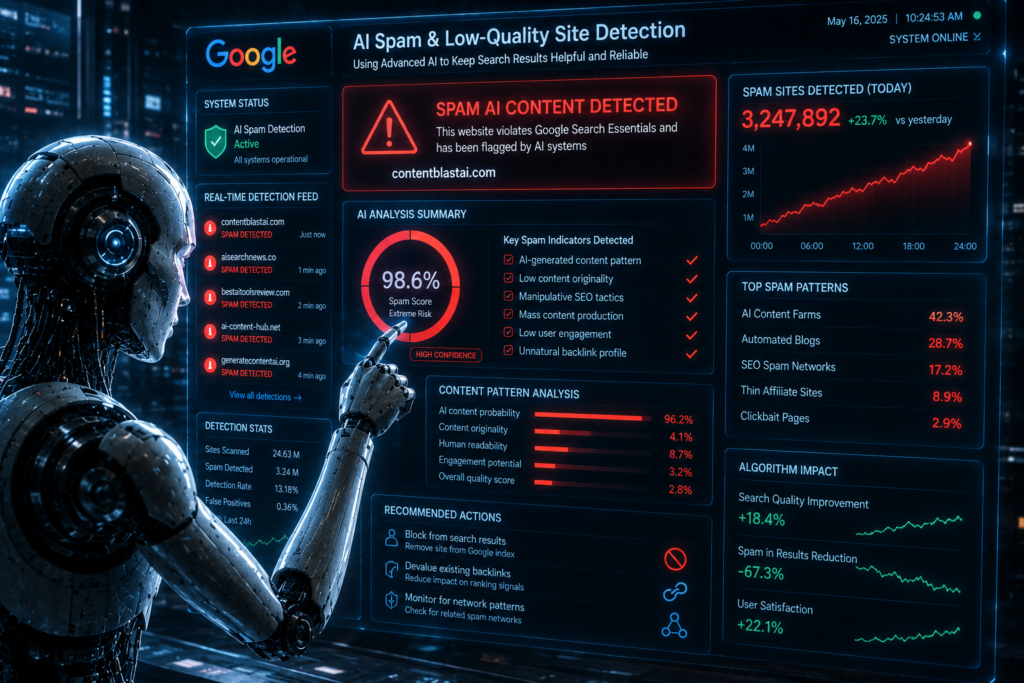
This topic is quite confusing for many people, because they often think Google has a simple tool to detect AI content.
It is a common misconception that Google ranks or rejects content solely by detecting AI.
In reality, Google uses various signals and systems to evaluate the quality, originality, and usefulness of content.
Google takes into account various quality-related signals and guidelines to understand content quality.
Google has clarified that its focus is not on whether content is written using AI, but rather on the content’s quality, originality, and usefulness to users. Therefore, using AI in itself is not an issue, but low-quality or spammy content can lead to quality-related problems.
1. Writing Pattern Analysis
Poorly edited AI-generated content often exhibits certain common patterns.
flow bahut smooth hota hai.
Kabhi kabhi itna smooth ki unnatural lagne lagta hai.
Example:
- har sentence similar length
- har paragraph same structure
- repetitive transitions
In human-written content, sentence structure and writing style vary naturally, making the content feel more natural and engaging.
Kabhi:
- short line
- emotional reaction
- random observation
- personal opinion
aa jata hai.
Aur honestly?
Such natural variations can make the content more authentic and engaging for readers.
It is also important to note that smooth writing alone cannot determine whether content is AI-generated. Many experienced human writers also produce polished content, and AI-assisted drafts can be made to sound natural through human editing.
2. E-E-A-T Signals
E-E-A-T principles are considered an important reference point for creating high-quality content because they highlight expertise and trustworthiness.
E-E-A-T ka matlab:
- Experience
- Expertise
- Authoritativeness
- Trustworthiness
Example:
Agar koi health article sirf AI-generated information se bana hai aur usme:
- doctor opinion nahi
- real example nahi
- practical experience nahi
Such content may lack trust signals, which can lower its perceived quality.
Lekin agar article me:
- real testing
- screenshots
- personal review
- genuine observation
ho, toh trust signals improve hote hain.
If you use AI, verify the facts, add your own original insights, and ensure the content undergoes a human review before final publication. This practice enhances both the trustworthiness and usefulness of the content.
3. User Engagement Signals
Ye bahut underrated factor hai.
Along with content quality, user experience is also important.
User engagement metrics are useful indicators for website owners, and a good user experience supports the overall quality of the content.
Jaise:
- users kitni der ruk rahe hain
- scroll kar rahe hain ya nahi
- instantly back ja rahe hain ya nahi
Agar readers article open karke 5 second me exit kar dete hain…
User engagement metrics are useful indicators for website owners, and a good user experience supports the overall quality of the content.
content useful nahi tha.
Aur honestly?
AI-generated boring content me ye problem common hai.
Using clear headings, practical examples, visuals, and easy-to-read formatting is also helpful for keeping readers engaged. This improves the overall reading experience of the content.
4. Publishing Speed
Maine kuch websites dekhi:
ek month me 500+ articles publish kar diye.
Aur sab AI-generated.
Sach bolu toh…
ye already suspicious lagta hai.
Especially new websites ke liye.
User engagement metrics are useful indicators for website owners, and a good user experience supports the overall quality of the content.
Isliye slow aur quality-focused growth zyada safe strategy hai.
The most important thing is to prioritize quality over quantity when publishing content. Whether an article is created with the help of AI or written manually, the final version must be accurate, original, and genuinely useful to readers.
Real Example – Ek Blog Ka Traffic Kaise Gira
In the case of a blogger, I observed noticeable changes in their website’s performance following large-scale AI-assisted publishing.
Unhone AI tools se:
- affiliate articles
- “best tools”
- review posts
bulk me publish kiye.
Initially, the website’s organic traffic and impressions improved.
After some time, a decline in the website’s performance was observed.
- impressions suddenly gir gaye
- rankings unstable ho gayi
- CTR drop ho gaya
They made these changes to improve performance.
They manually reviewed every article, updated outdated information, removed unnecessary repetition, and added practical examples and clear explanations for readers. The objective of this process was not merely to edit AI-generated content, but to improve the overall quality of the content.
Over the next few months, the website’s performance gradually improved. It is difficult to attribute this to a single reason, but improving content quality was a key part of those changes.
Keep in mind that a website’s traffic can be influenced by various factors, such as content quality, competition, search intent, technical SEO, and website updates. Therefore, a single change cannot be considered the definitive reason for an increase or decrease in traffic.
This example taught me something important:
This example illustrates that high-quality, original, and genuinely useful content is more important than merely polished language.
Therefore, using AI is not a problem. The most important thing is that the final content is accurate, original, well-reviewed, and genuinely useful for readers.
Kya AI Content SEO Ke Liye Safe Hai?
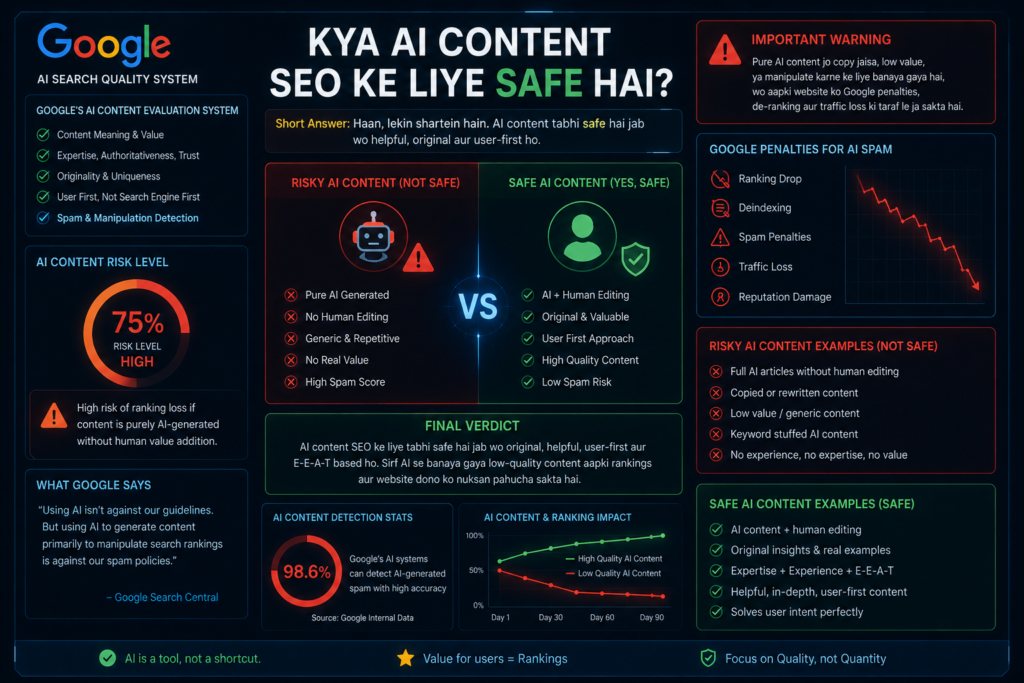
Short answer: Yes, but only if the final content is original, accurate, and genuinely helpful to users.
According to Google’s publicly available guidance, the tool used to write the content matters less than whether it is original, accurate, and genuinely useful to users. Therefore, using AI is not a problem in itself, but low-quality or spammy content can affect both rankings and user trust.
The biggest difference in achieving success in SEO comes from this approach.
Today, many businesses, publishers, bloggers, and content creators use these tools for tasks such as brainstorming, drafting, and editing.
- agencies
- media sites
- bloggers
- YouTubers
sab AI assistance use kar rahe hain.
Creators who publish high-quality content generally follow an important practice.
Woh AI output ko directly publish nahi karte.
Woh:
They fact-check the AI-generated draft, add their own original insights, make the language natural, and manually review the final content before publishing it.
Before publishing the final article, it is considered good practice to fact-check the content, update outdated information, add practical examples, and remove unnecessary repetition. This improves both the quality and readability of the article.
Aur honestly?
This approach can help improve content quality, trustworthiness, and long-term SEO performance.
If AI is used as an assistant and the final content is published after human review, both quality and user experience can be improved. The focus should always be on providing accurate and valuable information to readers.
Bloggers Ki Sabse Badi Mistakes
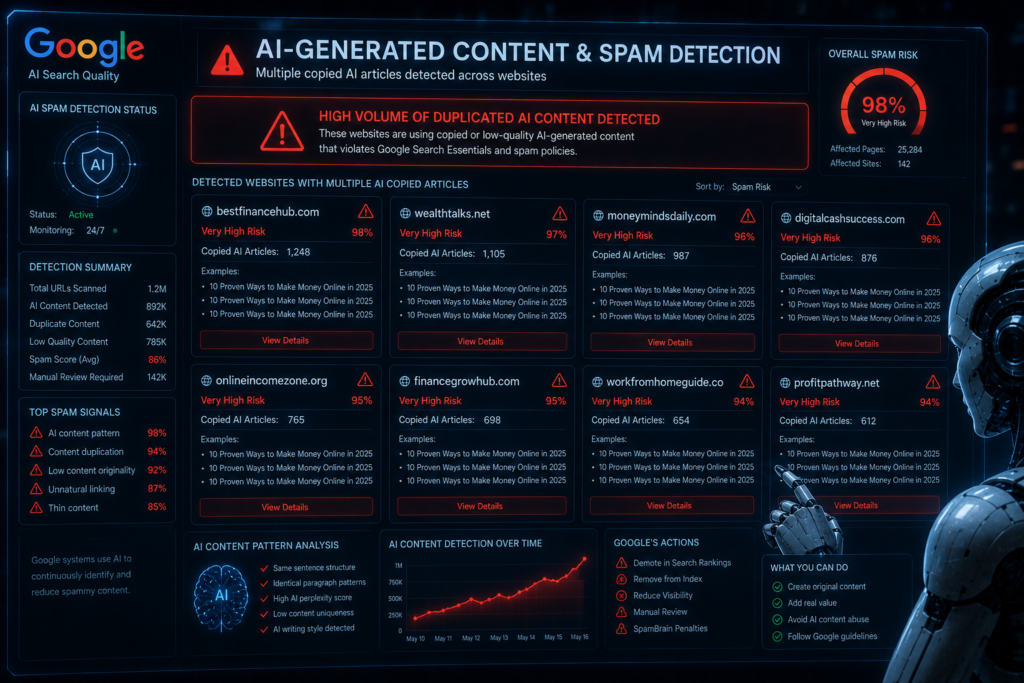
1. Direct Copy-Paste Publishing
Ye sabse common mistake hai.
AI se article generate karo…
aur bina padhe publish kar do.
Before publishing an article, always verify the facts, check the grammar, add your original insights, and manually review the content. This process improves the quality and trustworthiness of the article.
This approach could increase the risk of factual errors, repetitive content, and low user value, which may affect long-term content quality.
2. Generic Content
Aise articles:
- har website par same lagte hain
- koi unique value nahi dete
Such content may lack originality and user value, which could negatively impact search performance.
Generic content is content that merely repeats information from other websites using different words, without offering any new examples, analysis, or practical value. Such content does not provide any unique benefit to readers.
3. Unverified Expertise or Overly Broad Topic Coverage
Kuch blogs har topic cover karte hain:
- health
- crypto
- finance
- SEO
- tech
Often, a single author profile covers topics requiring vastly different areas of expertise, without clearly explaining the relevant experience or qualifications.
Honestly?
This can erode reader trust and raise questions about the credibility of the content.
4. Keyword Stuffing
“Google AI Spam Update 2026”
ko har line me repeat karna SEO nahi hai.
Using keywords in a natural context and creating content that is helpful to users is a far more effective approach than keyword stuffing.
If a keyword is repeated in every sentence, the content can seem unnatural. Instead, it is more effective to use the keyword naturally in headings, the introduction, and relevant sections.
AI Content Ko Human Kaise Banaye?
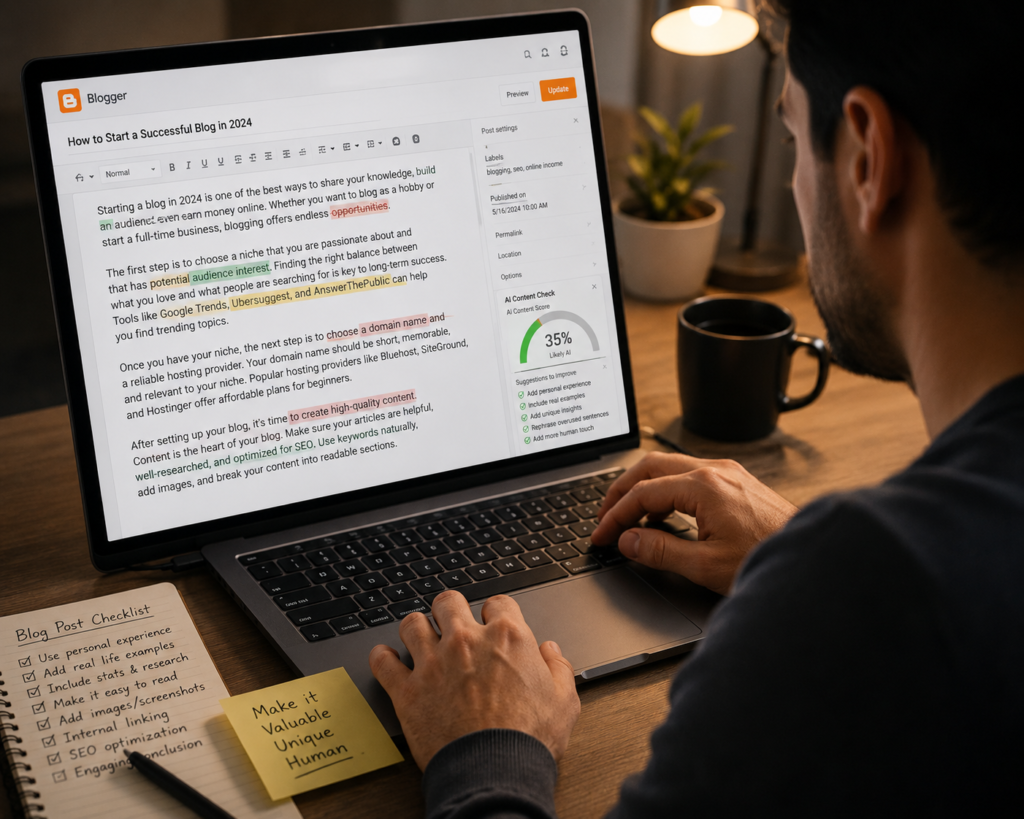
Ab practical part.
If these strategies are applied consistently, AI-assisted content can be made more natural, useful, and reader-friendly.
1. Personal Opinions Add Karo
Example:
Only include personal opinions or experiences that you have genuinely observed or tested yourself. Never use fake experiences or fabricated claims.
Genuine personal insights aur original observations content ko zyada authentic bana sakte hain, lekin ye sirf tab effective hote hain jab wo sach aur relevant hon.
2. Real Examples Use Karo
Case studies.
Observations.
Mistakes.
Real-life examples and practical observations help readers understand the topic better and add original value to the article.
If you are writing a review of an AI tool, instead of just listing its features, explain the purpose for which you used it, the results you achieved, and its limitations. Such practical context makes the article more useful.
3. Keep your writing style natural.
Keep every sentence natural and conversational, but do not compromise on clarity and readability.
Kabhi:
Add original observations, practical insights, and natural transitions wherever relevant. Do not use emotional language solely for the sake of adding emotional lines.
add karo.
4. AI Draft Ko Rewrite Karo
At least:
- intro
- conclusion
- important sections
khud rewrite karo.
Simply changing words isn’t enough when rewriting. Verify the facts, remove unnecessary repetition, add your own examples, and ensure that every section clearly answers the reader’s question.
5. Images Aur Screenshots Add Karo
Original screenshots and visuals help readers understand the process, make the article more trustworthy, and improve the user experience. If images are properly optimized (such as by using descriptive file names and alt text), they can indirectly support SEO.
SEO me bhi help karte hain.
The most important thing is to use AI as a writing assistant rather than a content writer. Before publishing the final article, review it manually, verify the facts, and be sure to add your own original insights.
Future of AI Blogging

Given current trends and Google’s publicly available guidance, AI-assisted blogging is likely to remain relevant, but content quality will become more important than ever.
AI blogging khatam nahi hone wala.
Bas evolve hone wala hai.
Future me:
Since both AI tools and search systems will continue to evolve, regularly updating content, verifying facts, and making improvements based on reader feedback—rather than relying solely on automation—should be a key part of your long-term strategy.
- It can be difficult to maintain good performance for low-quality and repetitive AI-generated content.
- helpful AI-assisted content survive karega
- personal branding important hogi
- topical authority zyada matter karegi
In this environment, creators who publish original, accurate, and genuinely helpful content can benefit.
Long-term success ke liye sustainable content quality aur user value par focus karna zyada important hoga.
Myths vs Reality
Myth:
“AI content kabhi rank nahi karega.”
Reality:
High-quality AI-assisted content search results me achha perform kar sakta hai, jab wo original, accurate aur users ke liye genuinely helpful ho.
Myth:
“Long article automatically rank karta hai.”
Reality:
Quality > word count.
Myth:
“Hinglish blogs safe hain.”
Reality:
Google content ki quality ko language se zyada uski usefulness, relevance aur originality ke basis par evaluate karne ki koshish karta hai.
Myth:
“AI detector score hi sab kuch hai.”
Reality:
Google focuses on showing content that is helpful and satisfying to users; therefore, content quality matters more than AI detector scores.
The common thread among these myths is that neither the mere use of AI nor the length of an article determines success. The most important factor is whether the content provides clear, accurate, and useful answers to the readers’ questions.
SEO Tips for 2026
- Internal linking strong rakho
- AI ko assistant ki tarah use karo
- Personal stories add karo
- Original images use karo
- Topical authority build karo
- Consistent publishing rakho
- Helpful content likho
- Reader engagement improve karo
You don’t need to follow all these tips at once. First, focus on content quality, search intent, and user experience. Then, gradually improve elements like internal linking, original visuals, and topical authority. Consistent, quality-focused improvements are more effective for long-term results.
How to Humanize AI Content for Free

How to Humanize AI Content for Free – AI Articles Ko Human Kaise Banaye?
To be honest…
Today, many bloggers and content creators use tools for tasks such as brainstorming, drafting, and editing.
Some are using ChatGPT.
Some, Claude.
Others, Gemini.
These tools have made the content creation process significantly faster and more efficient.
However, simply generating an article using AI is not enough. The quality of the final content depends on how much it has been reviewed, edited, and improved.
But the problem starts when the article:
- robotic lagta hai
- repetitive lagta hai
- The content starts to feel unnatural or repetitive.
Many beginners make the mistake of publishing AI-generated drafts without reviewing them.
I generated an article using AI…
did a bit of formatting…
and published it straight away.
Initially, I thought:
I felt that the article was ready to be published.
But when I read the article again…
It lacked original insights, practical examples, and a natural writing style.
And this is exactly where most bloggers go wrong.
They mistake AI for a writer.
Whereas smart bloggers use AI like an assistant.
This means using AI to generate ideas, create outlines, or write a first draft, while ensuring that human review, fact-checking, and original insights are incorporated into the final content.
So, if you too…
Agar AI-generated article bina review ke publish kiya jata hai, to usme repetitive wording, factual mistakes ya low originality jaise issues aa sakte hain. Isi liye human editing content creation process ka important hissa hai.
- AI articles likhte ho
- ChatGPT content publish karte ho
- AI detection score kam karna chahte ho
- ya article ko natural banana chahte ho
toh ye guide tumhare liye hai.
Here, you will find practical methods, examples, and blogging best practices that can help make AI-assisted content more natural and useful.
- free methods
- practical tricks
- real examples
- aur actual blogging experience
share karne wala hoon jo genuinely kaam aate hain.
Is guide ke end tak aapko ek practical workflow milega jise follow karke aap AI-assisted articles ko zyada natural, trustworthy aur readers ke liye genuinely useful bana sakte hain.
AI Content Robotic Kyun Lagta Hai?

Pehle ye samajhna important hai.
These patterns are often observed in unedited AI-generated drafts:
- overly clean hota hai
- same tone me likha hota hai
- predictable structure follow karta hai
- emotions weak hote hain
“Robotic content” refers to text that is technically correct but lacks original insights, natural flow, or practical value from the reader’s perspective. Such content often feels generic.
Example:
AI Style
“AI tools are very useful for bloggers because they help generate content quickly and efficiently.”
This sentence is grammatically correct, but it lacks elements of personal insight, context, and natural conversation.
Using conversational language alone isn’t enough. Human-style content should also include relevant examples, clear explanations, and genuine insights to ensure the reader derives real value.
Human Style
“Honestly, agar aap blogging karte ho toh AI tools time literally half kar dete hain. Lekin blindly use karoge toh content robotic lagne lagta hai.”
The difference is clearly visible when comparing the two examples.
Second version:
- conversational hai
- opinion hai
- emotion hai
- real lag raha hai
Such natural, useful, and reader-focused content can be more engaging for users and aligns better with Google’s publicly available quality guidance.
Kya AI Humanizer Tools Zaruri Hain?
Har baar nahi.
Kai bloggers sochte hain:
“Bas AI humanizer tool use kar lo aur problem solve.”
Reality ye hai ki sirf AI humanizer tool use karna kaafi nahi hota. Final content ki quality human review aur editing par bhi depend karti hai.
Maine personally kaafi free AI humanizer tools test kiye hain.
Kuch AI humanizer tools wording ko unnatural bana sakte hain, grammar ko affect kar sakte hain ya readability ko reduce kar sakte hain. Isliye final review hamesha manually karna chahiye.
Isliye best strategy hoti hai:
AI + manual editing.
Using AI as a writing assistant and manually reviewing the final content is considered a practical and sustainable approach in the long run.
AI humanizer tools can help make the wording sound natural in some cases, but they should not be considered the final solution. It is equally important to manually review and fact-check every article before publishing it.
The most effective workflow is to first prepare a draft using AI, then add original insights, practical examples, and accurate information. Finally, publish the article only after a thorough proofreading.
Best Free Ways to Humanize AI Content
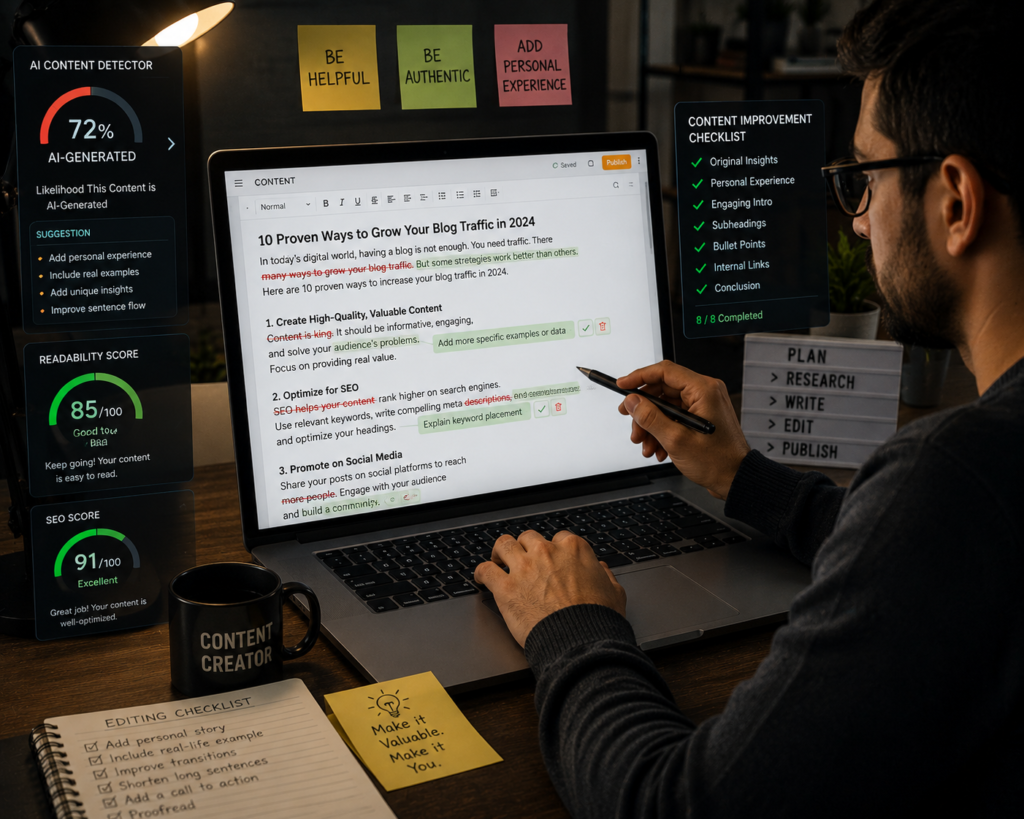
Ab practical methods ki baat karte hain.
If these methods are applied thoughtfully, AI-assisted content can be made more natural and reader-friendly.
These techniques are commonly recommended as best practices for content editing and writing.
1. Personal Opinion Add Karo
Ye sabse powerful trick hai.
Example:
Instead of:
“AI content is useful.”
Write:
“Mere experience ke according AI content useful hai, lekin bina editing ke publish karna risky ho sakta hai.”
Such original insights can make the article more authentic and reader-focused.
Include personal opinions only when they are based on your actual experience or observations. Never use fake experiences or fabricated stories solely to make the content appear more human.
2. Real Examples Use Karo
Unedited AI-generated drafts can often feel generic.
Real examples usse unique banate hain.
Example:
“Maine ek AI article direct publish kiya tha aur uska bounce rate bahut high tha.”
If this is your genuine experience, such an example can enhance the article’s originality and trustworthiness.
If you do not have an example of your own, you can refer to publicly available case studies or verified examples. Always ensure that the information is accurate and properly represented.
3. Mixed Sentence Length Use Karo
In some AI-generated drafts, sentence rhythm can be quite uniform, especially when they haven’t been edited.
Human writing:
- kabhi short
- kabhi long
- kabhi emotional
hoti hai.
Example:
“Fir maine article rewrite kiya. Aur honestly? Difference shocking tha.”
A natural mix of short and long sentences can make the content more engaging to read.
Sentence length vary karte waqt readability ka dhyan rakhein. Bahut zyada short ya bahut zyada long sentences dono hi reading experience ko affect kar sakte hain.
4. Questions Add Karo
Relevant questions make readers think and can motivate them to read on to the next section of the article.
Example:
“Lekin kya sirf AI detector score hi important hai?”
Ye conversational flow improve karta hai.
5. Maintain a natural, human writing style.
Yahi jagah hai jahan most log over-editing kar dete hain.
Keep every sentence natural and easy to read, but do not compromise on clarity and accuracy.
Thoda natural flow rakho.
Kabhi:
- reaction
- pause
- opinion
add karo.
The objective of these techniques is not to artificially make AI content appear human, but rather to make it more useful, natural, and trustworthy for readers. When content possesses originality, clarity, and practical value, its overall quality improves as well.
Best Free AI Writing & Editing Tools for Humanizing Content

Ab tools ki baat karte hain.
No tool guarantees perfect results. The purpose of these tools is to simplify the editing process, but the final content should always be reviewed manually to ensure accuracy, originality, and readability.
1. QuillBot
This tool can be useful in these situations:
- sentence rewriting
- readability improvement
- tone variation
Free version beginners ke liye enough hai.
Be sure to read the rewritten lines before publishing them, as the original context or meaning of the wording might sometimes change.
2. Hemingway Editor
This is not a dedicated tool for this purpose, but it may fail to improve readability and sentence clarity.
lekin readability improve karne ke liye amazing hai.
Many writers use this tool for readability reviews.
3. Grammarly
Grammar improve karta hai.
Lekin over-polish mat karna.
Instead of blindly accepting every suggestion, it is better to review them based on the context so that the writing remains natural.
Do not treat grammar suggestions as final decisions. If a suggestion alters the article’s natural tone or intended meaning, it is better to adjust it manually.
4. Undetectable AI
It is known for its text rewriting and humanization features.
Lekin free version limited hai.
AI humanizer tools should not be viewed as a shortcut. They are best utilized when you first review the content yourself and then accept only those suggestions that genuinely improve the quality of the article.
| Tool | Best Use | Limitation |
|---|---|---|
| QuillBot | Sentence rewriting | Meaning ko manually verify karein |
| Hemingway Editor | Readability improvement | Grammar correction nahi karta |
| Grammarly | Grammar aur clarity | Har suggestion blindly accept na karein |
| Undetectable AI | Text rewriting | Free version limited ho sakta hai |
AI Detector Score Kam Kaise Kare?
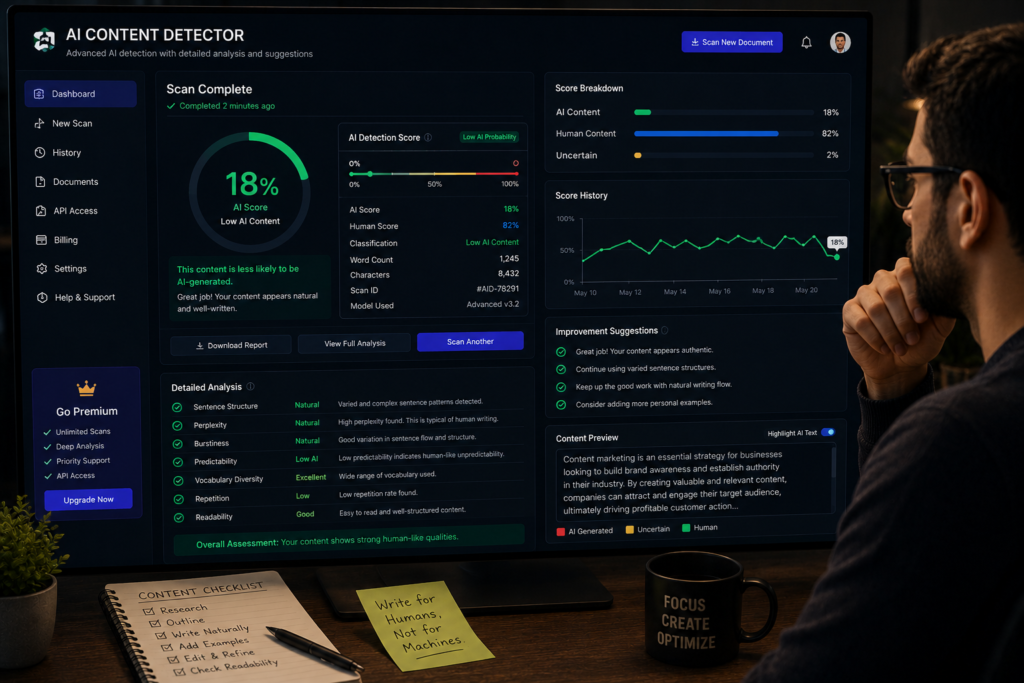
Honestly…
There is a lot of confusion and discussion surrounding detector scores.
Lekin ek important baat samjho:
Woh:
Google ki publicly available guidance content ki quality, originality aur users ke liye usefulness par zor deti hai.
dekhte hain.
Fir bhi agar score reduce karna hai toh:
- personal stories add karo
- examples add karo
- repetitive wording remove karo
- robotic transitions avoid karo
- Add natural observations or genuine insights where relevant.
This does not mean that content quality does not matter. If an article is repetitive, inaccurate, or of little use to readers, it can negatively impact its overall quality and the user experience.
Real Example – AI Article Ka Transformation
In an observed example, some improvements were tested after publishing an AI-assisted article.
Initial version:
- perfectly structured tha
- grammar clean thi
- AI detector score high tha
Lekin engagement weak tha.
Fir maine:
- intro rewrite kiya
- personal observations add kiye
- short emotional lines add ki
- examples add kiye
After some time, an improvement in the article’s engagement metrics was observed. This improvement cannot be attributed to a single factor, but changes made to the content quality could be a contributing factor.
Ye ek important lesson tha:
Readers often find content featuring natural language, practical examples, and original insights to be more engaging.
This example is merely an observation. A website’s performance can also be influenced by various factors such as competition, search intent, technical SEO, and content quality.
Common Mistakes Bloggers Karte Hain
1. Direct Copy-Paste
Sabse common mistake.
2. Overusing AI Words
Transition words are useful, but excessive repetition can make the writing sound unnatural.
3. Fake Stories Add Karna
Readers fake examples quickly samajh jaate hain.
Authentic raho.
4. The reader gets a clearer meaning.
Kabhi kabhi log article ko unnecessarily awkward bana dete hain.
Balance important hai.
If you publish AI-assisted content, focus on clarity, originality, factual accuracy, and user value rather than the AI detector score. This approach is more sustainable in the long run.
Kya AI Content Future Me Rank Karega?

Mere experience ke according:
Haan.
Lekin sirf wahi content:
- useful ho
- human edited ho
- unique ho
- engaging ho
survive karega.
Generic AI spam ka future honestly weak lagta hai.
FAQs
Q1. Kya Google AI-generated content ko punish karta hai?
Directly nahi.
Low-quality spam content ko target karta hai.
Q2. Kya AI content future me rank karega?
Haan, agar:
- edited ho
- useful ho
- human touch ho
Q3. Kya beginners AI blogging start kar sakte hain?
Bilkul.
Lekin sirf copy-paste strategy avoid karo.
Q4. Kya AI detector tools accurate hote hain?
100% nahi.
Kabhi human content ko bhi AI bol dete hain.
Q5. Kya Hinglish content SEO me kaam karta hai?
Haan.
Aaj Hinglish audience bahut fast grow kar rahi hai
Q6. Kya AI humanizer tools free hote hain?
Haan, kai tools free versions provide karte hain.
Q7. Kya AI detector tools accurate hote hain?
100% nahi.
Kabhi human content ko bhi AI bol dete hain.
Q8. Kya ChatGPT content rank kar sakta hai?
Haan, agar properly edited aur useful ho.
Q9. Kya AI content ko manually edit karna zaruri hai?
Honestly? Haan.
Long-term SEO ke liye helpful hota hai.
Q10. Sabse important humanization trick kya hai?
Personal experience aur real examples.