

Quality content plays an important role in blogging, marketing, social media, and other digital workflows. Whether you are a blogger, YouTuber, freelancer, or business owner, creating useful and consistent content can be an important part of building an online presence.
However, producing useful content often involves research, outlining, writing, editing, and fact-checking, which can take considerable time.
This is where AI writing tools can assist with different parts of the content-creation process. In this guide, we’ll compare the Best AI Writing Tools 2026 and explain what different types of AI writing tools can help you accomplish.
Depending on the platform, an AI writing tool may help you:
- Create a first draft from an outline or prompt
- Develop ideas and content structures
- Draft YouTube scripts and other short-form content
- Improve grammar, clarity, and readability
- Generate keyword and content ideas
- Assist with on-page SEO elements
AI writing tools are not a replacement for research, fact-checking, editing, or human judgment. Their usefulness depends on the task, the tool you choose, and how you review and refine the generated content.
In this detailed guide, we’ll cover:
- The Future of AI-Assisted Writing
- Best AI Writing Tools 2026
- What AI Writing Tools Are and How They Work
- Key Benefits and Limitations
- Features to Look for When Choosing a Tool
- Practical Tips for Using AI Writing Tools
- Common Mistakes to Avoid
- The Future of AI-Assisted Writing
Best AI Writing Tools 2026
AI writing tools can assist with a range of content tasks, from brainstorming and drafting to editing and content optimization.
Tasks such as researching a topic, creating an outline, drafting content, and editing the final copy can require significant time, depending on the type and complexity of the project.
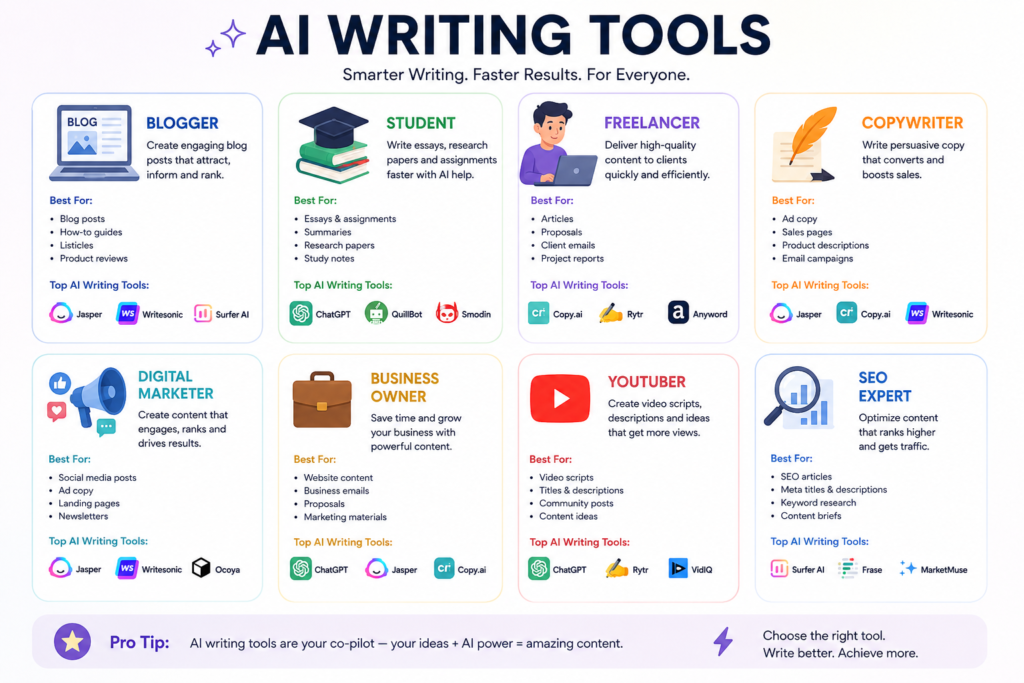
AI writing tools can now assist with several parts of this workflow, although the amount of assistance and the quality of the output vary between tools and use cases.
These tools can be useful for:
- Bloggers
- Students
- Freelancers
- Copywriters
- Digital marketers
- Business owners
- YouTubers
- SEO professionals
Depending on the platform, AI writing tools can help users:
- Generate article ideas
- Create outlines and first drafts
- Draft emails and other business content
- Improve grammar and readability
- Rewrite or simplify existing text
- Generate social media caption ideas
- Suggest on-page SEO improvements
- Create product-description drafts
- Help organize research notes
AI writing tools can help reduce repetitive writing tasks and support productivity when used as part of a broader content workflow. However, important content should still be reviewed for accuracy, originality, clarity, and suitability for the intended audience.
Why Are AI Writing Tools Becoming Popular?
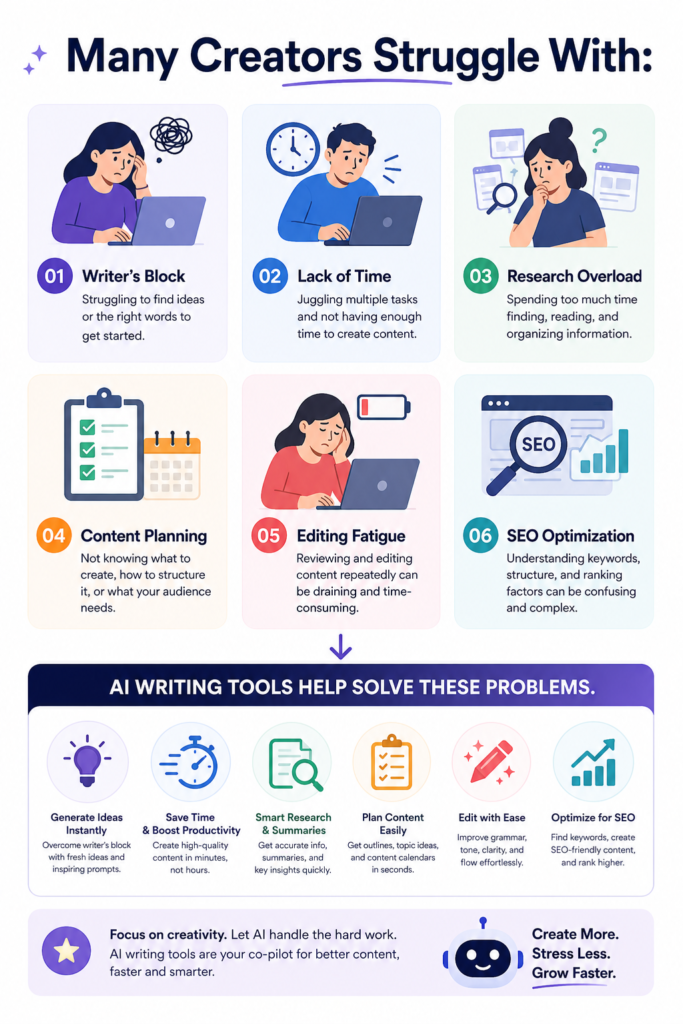
Creating useful content consistently can be challenging, especially when a creator is managing research, writing, editing, publishing, and other responsibilities at the same time.
Many creators and businesses face challenges such as:
- Writer’s block
- Limited time
- Large amounts of research
- Content planning
- Repetitive editing tasks
- SEO research and optimization
AI writing tools can assist with some of these challenges by supporting brainstorming, drafting, editing, and content planning.
Instead of starting every piece of content from scratch, users can use AI tools to generate or develop:
- Outlines
- Headings
- Article ideas
- First drafts
- Social media posts
- Video scripts
The exact capabilities and output quality vary between tools and tasks. Used as part of a broader workflow, AI writing tools can reduce some repetitive work and give creators more time to focus on editing, creative direction, fact-checking, and content strategy.
What Are AI Writing Tools?

AI writing tools are software applications that use artificial intelligence to assist with tasks such as brainstorming, drafting, rewriting, editing, summarizing, and content planning. Some tools can also generate text from prompts or other instructions.
Depending on the system, these tools may use technologies such as natural language processing, machine learning, and large language models to process instructions and generate or transform text.
AI writing tools can assist with tasks such as:
- Blog post drafts
- YouTube scripts
- Emails
- Social media posts
- Product descriptions
- Ad copy
- SEO content drafts and optimization suggestions
- Stories and creative writing
Modern AI writing tools can process instructions about tone, audience, style, and writing goals, although the quality and consistency of the results vary between tools and tasks.
For example, you could give an AI writing tool a prompt such as:
“Write a beginner-friendly article about the best AI writing tools in 2026, with practical comparisons and SEO-friendly headings.”
Depending on the tool, it may then:
- Generate a draft based on the instructions
- Suggest a heading structure
- Suggest keyword placement and related topics
- Help improve readability and sentence structure
These capabilities can make AI writing tools useful for creators who want assistance with different stages of the writing process. However, important content should still be reviewed for accuracy, originality, context, and suitability for the intended audience.
Features to Look for in AI Writing Tools
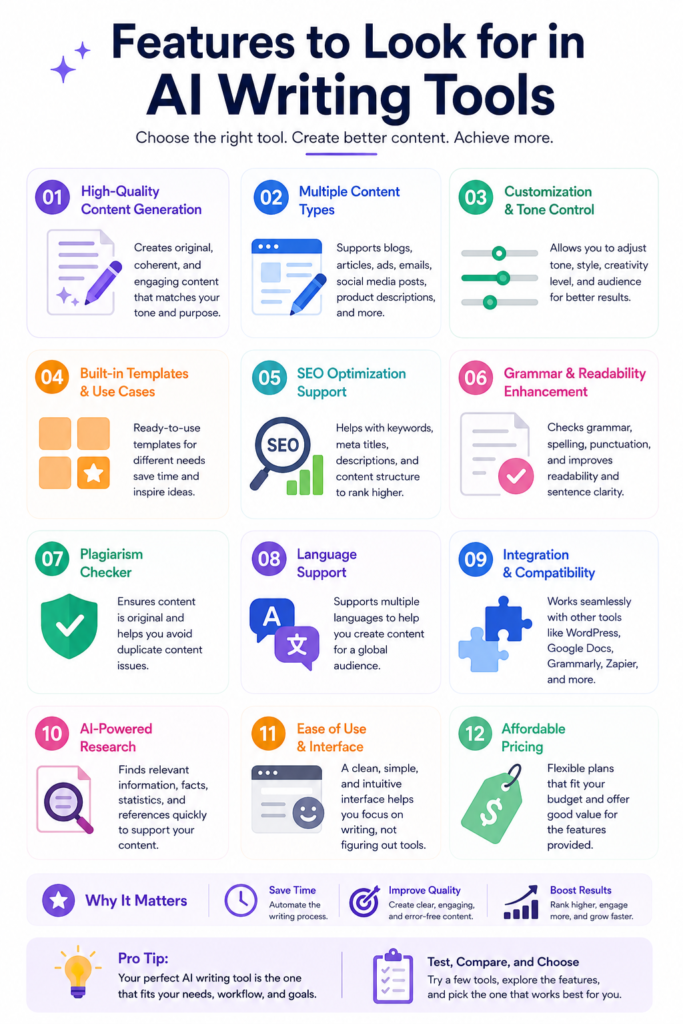
Before choosing an AI writing tool, compare the features that match your actual content workflow rather than choosing a platform based only on its feature list.
1. Content Quality
The tool should produce clear, coherent drafts that can be reviewed and edited for the intended audience.
Poor-quality AI-generated content can affect:
- Readability
- User trust
- Content usefulness
- Overall publishing quality
2. SEO and Content Optimization Features
Some AI writing tools provide assistance with:
- Keyword research or keyword suggestions
- Content structure
- Headings
- Readability
- Meta descriptions
- Related topic suggestions
These features can support an SEO workflow, but AI-generated recommendations should be reviewed rather than accepted automatically.
3. Ease of Use
A clear interface can make it easier to learn the tool and integrate it into an existing writing workflow.
Beginners may prefer tools with straightforward navigation, while advanced users may value more customization and control.
4. Grammar and Editing Support
Grammar and editing features can help identify spelling, grammar, clarity, and style issues before publication. Human review is still useful for checking context, meaning, and accuracy.
5. Templates
Templates can provide starting structures for common content types such as:
- Blog posts
- Ads
- Emails
- Landing pages
- Social media captions
- Product descriptions
This can reduce the amount of setup required when creating recurring types of content.
6. Pricing and Usage Limits
Compare pricing based on your actual usage rather than choosing only the cheapest plan. Check monthly limits, word or credit allowances, included features, team access, and whether important features are restricted to higher tiers.
7. Research and Fact-Checking Support
If a tool provides research or web-access features, check whether it can provide sources or citations and how current that information is. AI-generated facts should still be independently verified before publication.
8. Integrations and Export Options
Consider whether the tool works with the platforms you already use, such as document editors, content management systems, or other productivity tools. Easy export and integration can make the overall workflow more convenient.
Why AI Writing Tools Matter for Content Creation in 2026
Creating consistent, useful content can be challenging as creators and businesses manage multiple publishing channels and content formats.
As content demands increase, creators may benefit from workflows that make research, drafting, editing, and content planning more manageable.
AI writing tools can support several of these tasks by assisting with brainstorming, drafting, editing, and content planning. Their usefulness depends on the tool, the type of content, and how the generated output is reviewed and refined.
1. Support Faster Drafting
AI writing tools can help create outlines, first drafts, and content variations without requiring every sentence to be written from scratch. The amount of time saved depends on the topic, tool, and level of human editing required.
2. Reduce Repetitive Writing Work
AI can assist with recurring tasks such as rewriting, summarizing, formatting, brainstorming, and creating initial drafts. This may allow creators to spend more time on research, editing, and content strategy.
3. Assist With SEO Workflows
Some AI writing tools can help with keyword ideas, content outlines, headings, meta descriptions, readability suggestions, and related topics. These recommendations should be reviewed and adapted to the actual search intent and content.
4. Support Brainstorming
When you are unsure what to write about, AI tools can generate topic ideas, angles, outlines, questions, and content concepts that can be used as starting points. The final topic should still be evaluated for relevance, originality, and audience needs.
5. Potentially Reduce Some Production Costs
AI tools can reduce some repetitive writing work for certain workflows. However, subscriptions, editing, research, fact-checking, and professional writing or design support may still be necessary depending on the project.
6. Repurpose Existing Content
AI writing tools can help transform existing material into different formats, such as turning a long article into social media posts, email drafts, summaries, or video-script outlines. The source material should be reviewed to ensure that the rewritten version remains accurate and consistent with the original.
Comparison Table – Best AI Writing Tools 2026
Different AI writing tools are designed for different workflows. Instead of ranking them with arbitrary scores, this comparison focuses on their common use cases and strengths.
| Tool | Best For | Key Strength | Common Content Types | Pricing |
|---|---|---|---|---|
| ChatGPT | General writing and content workflows | Conversational writing, brainstorming, research and content assistance | Articles, scripts, emails, social posts, ideas | Check current plan options |
| Jasper AI | Marketing and brand content | Marketing-focused writing workflows | Marketing copy, campaigns, blog content, sales copy | Check current plans |
| Copy.ai | Marketing and short-form content | Marketing and sales-content workflows | Social posts, ads, sales copy, business content | Check current plans |
| Writesonic | SEO and content workflows | Content creation and SEO-related assistance | Blog posts, articles, marketing content | Check current plans |
| Grammarly | Writing improvement and editing | Grammar, clarity, style, and writing assistance | Articles, emails, documents, business writing | Check current plans |
| Notion AI | Productivity and content organization | AI assistance within a broader workspace | Notes, summaries, planning, drafts, documentation | Check current plans |
Note: Features, pricing, usage limits, and plan availability can change over time. Check each platform’s current official information before making a purchasing decision.
Category note: Grammarly is primarily a writing and editing assistant, while the other tools in this table can be used more directly for content generation and broader writing workflows.
Best AI Writing Tools 2026: Top Picks by Use Case
The following AI writing tools serve different content and writing workflows. Instead of treating one platform as the best for everyone, consider each tool based on its features, intended use, and workflow requirements.

1. ChatGPT – General-Purpose AI Writing and Content Assistant
ChatGPT can be used for a wide range of writing and content-related tasks, including brainstorming, drafting, rewriting, research assistance, and script development.
Best suited for:
- Blog drafts and outlines
- YouTube scripts
- Content brainstorming
- Research assistance
- Story and creative writing
Key capabilities:
- Long-form drafting
- Multiple writing styles and tones
- Content outlining and brainstorming
- Rewriting and editing assistance
- SEO and content optimization assistance
You can also instruct the tool to use different writing styles, such as professional, conversational, storytelling, or other appropriate tones.
Its broad range of writing and content workflows makes it a flexible option for users with different requirements.
2. Jasper AI – Marketing and Business Content
Jasper is designed primarily around marketing and business content workflows.
Best suited for:
- Marketing content
- Ad copy
- Email marketing
- Blog content
Key capabilities:
- Content templates
- Brand and tone controls
- Marketing-focused workflows
- Content optimization features
It may be worth considering if your primary requirement is marketing-oriented content rather than general-purpose writing.
3. Copy.ai – Marketing and Short-Form Content
Copy.ai provides AI-assisted workflows for marketing, sales, and short-form content.
Best suited for:
- Social media posts
- Short-form copy
- Email drafts
- Product descriptions
Key capabilities:
- Content templates
- Marketing workflows
- Content generation
- Writing assistance
Its suitability for beginners depends on the type of content you want to create and the workflow you prefer.
4. Writesonic – Content and SEO Workflows
Writesonic provides AI-assisted features for content creation and SEO-related workflows.
Best suited for:
- SEO content workflows
- Blog posts
- Product descriptions
- Landing-page content
Key capabilities:
- Content generation
- SEO-related assistance
- Long-form writing workflows
- Rewriting and editing
Users should still review AI-generated content for accuracy, search intent, originality, and overall quality before publishing.
5. Grammarly – Writing and Editing Assistant
Grammarly has expanded beyond traditional grammar checking to include broader writing and AI-assisted editing features.
Depending on the available features, Grammarly can assist with rewriting, tone, clarity, and other aspects of writing.
Best suited for:
- Editing
- Rewriting
- Professional writing
- Grammar and clarity improvements
Grammarly can be particularly useful when the main goal is to review, refine, and polish existing writing.
6. Notion AI – Writing and Content Organization
Notion AI can assist with writing and content organization inside a broader productivity workspace.
Best suited for:
- Content planning
- Notes
- Drafting
- Documentation
- Idea organization
Key capabilities:
- AI-assisted writing
- Content organization
- Summarization
- Workspace-based workflows
It can be useful for creators who want writing assistance alongside their notes, planning, and project-management workflow.
7. Rytr – Short-Form Writing and Content Assistance
Rytr is an AI writing tool focused on common short-form and content-writing tasks.
Best suited for:
- Short-form content
- Emails
- Social media posts
- Basic marketing copy
Key capabilities:
- Writing assistance
- Content templates
- Short-form content workflows
Before choosing any AI writing tool, compare its current features, usage limits, pricing, integrations, and terms of use with your specific requirements.
Best AI Writing Tools for Different Users and Use Cases
Different users have different writing requirements, so the most suitable AI writing tool depends on the task, workflow, and features you need. The following options may be worth considering for common use cases.
- For Bloggers — Writesonic
Useful for blog-focused content workflows, including article drafting and SEO-related assistance.
- For Marketers — Jasper AI
Designed around marketing and brand-content workflows, including campaigns, copy, and related content tasks.
- For Students — ChatGPT
Useful for brainstorming, explanations, outlining, summarization, and drafting when used appropriately. Students should review AI-generated information and follow their institution’s rules for AI-assisted work.
- For Grammar and Editing — Grammarly
Useful for checking grammar, spelling, clarity, tone, and rewriting existing content.
- For Productivity and Organization — Notion AI
Useful for notes, summaries, planning, documentation, and AI-assisted writing within a broader workspace.
- For Social Media Content — Copy.ai
Useful for creating and adapting short-form marketing and social-media content.
Tip: Before choosing a tool, compare its current features, usage limits, pricing, integrations, and terms of use with your specific requirements.
Common Mistakes Beginners Make
Using an AI writing tool can make parts of the writing process easier, but the quality of the final content still depends on how the tool is used and how the output is reviewed.
1. Publishing Raw AI-Generated Content
AI-generated text should not automatically be treated as publication-ready. Review the content for accuracy, originality, clarity, tone, factual claims, and relevance to the intended audience before publishing. Edit or rewrite sections where necessary.
2. Ignoring Search Intent and SEO Fundamentals
AI-generated content does not automatically become search-optimized. Content should address the reader’s search intent and follow appropriate SEO practices, including useful structure, descriptive headings, relevant keywords, internal linking where appropriate, and clear, helpful information.
3. Overusing Keywords
Repeating the same keyword unnecessarily can make content difficult to read and may result in keyword stuffing. Use the primary keyword naturally and include related terms where they genuinely help explain the topic.
4. Depending Entirely on AI
AI can assist with brainstorming, drafting, and editing, but it should not replace human judgment. Review the generated content, add original insights or examples where appropriate, verify important information, and make sure the final article reflects the needs of your audience.
Benefits of AI Writing Tools in 2026
AI writing tools can support different parts of the content-creation process, from brainstorming and drafting to editing and content planning. Their usefulness depends on the tool, the task, and how the generated output is reviewed.
1. Support Faster Content Creation
AI tools can help create outlines, drafts, and content variations without requiring every part to be written from scratch. The time saved depends on the topic, tool, and amount of editing required.
2. Assist With SEO Workflows
Some AI writing tools can assist with keyword ideas, content structure, headings, readability, and other SEO-related tasks. These suggestions should be reviewed based on search intent, relevance, and overall content quality.
3. Potentially Reduce Some Production Work
AI tools may reduce some repetitive writing work for certain workflows. However, professional writers, editors, researchers, or other specialists may still be useful depending on the complexity and requirements of the project.
4. Support Creativity and Brainstorming
AI tools can generate topic ideas, content angles, outlines, examples, and alternative approaches that creators can use as starting points for their own work.
5. Support a Consistent Workflow
AI-assisted workflows can make recurring tasks such as drafting, rewriting, and content repurposing more manageable. This may help creators maintain a more consistent publishing workflow when combined with proper planning and human review.
6. Repurpose Existing Content
AI writing tools can help transform existing content into different formats, such as social media posts, email drafts, summaries, or video-script outlines. The rewritten content should be reviewed to ensure that it remains accurate and consistent with the original material.
How AI Writing Tools Work

AI writing tools rely on technologies such as machine learning, natural language processing (NLP), deep learning, and, in many modern systems, large language models.
At a simplified level, the process can be understood in the following steps.
Step 1: Model Training
AI writing systems are trained on large amounts of data so that the underlying models can learn statistical patterns in language and text. The exact training data, methods, and architecture vary between models and providers.
Through this training, the model can learn patterns related to:
- Grammar and language structure
- Vocabulary and sentence patterns
- Writing styles
- Relationships between words and concepts
Step 2: Processing the User’s Prompt
When a user provides a prompt or other instructions, the system processes the input and identifies relevant information such as the requested topic, format, tone, length, and other constraints.
For example, a prompt might ask for a 1,000-word beginner-friendly article written in a professional tone.
Step 3: Generating the Response
The underlying model uses the information from the prompt and its learned language patterns to generate a response. Depending on the tool, the output may be a new draft, rewrite, summary, outline, email, script, or another type of text.
Step 4: Reviewing and Refining the Output
The generated text should be reviewed before publication or important use. Users may need to correct factual errors, improve clarity, adjust the tone, add original information, and remove unsupported or irrelevant statements.
The exact process and capabilities vary between AI writing tools, models, and platforms.
Best Tips to Use AI Writing Tools
Using AI writing tools effectively requires clear instructions, thoughtful editing, and a review process. The goal should be to use AI where it adds value while keeping human judgment involved in the final content.
1. Use Clear and Specific Prompts
Clearer and more specific prompts can often produce more useful results. Include details such as the topic, audience, format, tone, length, and important requirements.
Example:
“Create an outline for a beginner-friendly article about the best AI writing tools in 2026. Include key features, use cases, limitations, a comparison section, and FAQs. Keep the tone clear and practical, and avoid unsupported claims.”
Starting with an outline can make it easier to review the structure before developing the full article.
2. Review and Edit the Generated Content
Review AI-generated text for accuracy, clarity, tone, repetition, unsupported claims, and relevance. Add your own examples, experience, analysis, or useful context where appropriate.
3. Add Original Experience or Insights
When relevant, add genuine personal experience, original examples, observations, test results, or practical lessons. Do not invent experience or claim to have tested a tool if you have not actually done so.
4. Use Different Tools When They Add Real Value
Different tools may be useful for different stages of a workflow. For example:
- ChatGPT — Brainstorming, drafting, rewriting, and content development
- Grammarly — Grammar, clarity, tone, and editing assistance
- Writesonic — Content creation and SEO-related workflows
Choose tools based on the task rather than using multiple platforms simply for the sake of using them.
5. Prioritize Quality Over Volume
Producing more AI-generated content does not automatically make a content strategy more effective. Focus on useful information, originality, accuracy, clear structure, and the needs of your audience rather than publishing as much content as possible.
6. Verify Important Information
AI-generated content can contain incorrect, outdated, or unsupported information. Verify important facts, statistics, product details, prices, policies, and other time-sensitive claims before publishing.
7. Treat AI Output as a Draft
Use AI-generated text as a starting point rather than automatically treating it as the final version. Review the structure, improve the writing, add useful information, and remove anything inaccurate or unnecessary before publication.
Common Mistakes to Avoid
AI writing tools can make parts of the content-creation process easier, but poor workflows can reduce the usefulness and quality of the final content. Avoid these common mistakes when using AI for writing.
1. Publishing AI Content Without Reviewing It
AI-generated text should be reviewed before publication. Check accuracy, clarity, repetition, tone, unsupported claims, and whether the content actually answers the reader’s needs. Add original examples or useful context where appropriate.
2. Overusing Keywords
Repeating a keyword unnecessarily can make content difficult to read and may result in keyword stuffing. Use the primary keyword naturally and include related terms only when they genuinely add context.
3. Skipping Fact-Checking
AI-generated content can contain inaccurate, outdated, or unsupported information. Verify important facts, statistics, product details, prices, policies, and other time-sensitive claims before publishing.
4. Using Vague Prompts
Short or unclear prompts may produce generic results. Include relevant details such as the topic, audience, purpose, format, tone, length, and specific requirements to give the AI enough context.
5. Publishing Generic Content Without Adding Original Value
AI can produce broadly useful drafts, but generic information may not fully address the needs of a specific audience. Add original examples, practical insights, comparisons, genuine first-hand observations, or other useful information that makes the content more relevant.
6. Relying Entirely on AI
AI should support the writing process rather than replace human judgment. Review the output, verify important information, and make the final content decisions yourself.
Expert Tips
Using AI writing tools effectively is less about generating as much content as possible and more about building a reliable workflow around them.
1. Combine AI Assistance With Human Expertise
Use AI for brainstorming, outlining, drafting, or repetitive writing tasks, then add human judgment, original insights, examples, and editing to improve the final content.
2. Use AI to Support Content Planning
AI writing tools can help generate topic ideas, organize content themes, create draft publishing schedules, and suggest content formats. Review the suggestions against your audience, niche, and actual publishing goals before adding them to your calendar.
3. Use AI for Keyword and Topic Research Assistance
AI tools can help generate keyword ideas, related topics, search-intent questions, and content angles. Use dedicated SEO tools and reliable search data when you need validated search volume, competition, or other keyword metrics.
4. Build Reusable Prompt Templates
Create reusable prompts for recurring tasks such as article outlines, product descriptions, email drafts, social media posts, or content refreshes. Keep the core structure consistent while changing the topic, audience, and specific requirements for each task.
5. Use Quality Checks Before Publishing
Before publishing AI-assisted content, check facts, originality, search intent, structure, readability, and unnecessary repetition. A consistent review process is especially useful when producing content regularly.
The Future of AI Writing Tools
AI writing tools are likely to become more capable as language models, interfaces, and supporting technologies continue to develop. Future improvements may focus not only on text generation but also on how AI integrates with research, editing, planning, and other content workflows.
Some potential trends include:
1. Voice-Based Writing and Editing
AI writing platforms may offer more natural voice-based interfaces, allowing users to create, revise, and interact with content through spoken instructions.
2. More Automated Content Workflows
Future tools may assist with multiple stages of content creation, including research, outlining, drafting, formatting, editing, and content repurposing. Human review will still be important for accuracy and quality.
3. Multimodal Content Creation
AI writing tools may increasingly connect text-based workflows with images, audio, scripts, and video. This could make it easier to move from a written idea to different content formats within a connected workflow.
4. More Integrated SEO Assistance
AI platforms may provide more contextual assistance with topics, content structure, search intent, related terms, and on-page optimization. These recommendations should still be evaluated using reliable SEO data and the actual needs of the audience.
5. Greater Importance of Human Review
As AI-generated content becomes easier to produce, the ability to evaluate information, provide clear instructions, add original insights, and make final editorial decisions may become increasingly important.
Rather than assuming that AI will completely replace writers, it may be more useful to view these tools as assistants that can automate some repetitive tasks while leaving research, judgment, creativity, and final editorial decisions to people.
Best AI Blog Writing Tools in 2026: Free and Paid Options
Choosing an AI writing tool depends on the type of content you create, the features you need, and how much control you want over the writing process. Bloggers may prioritize long-form drafting and SEO assistance, while marketers and freelancers may need different workflows.
Modern AI writing tools can assist with tasks such as drafting, rewriting, content planning, editing, and, depending on the platform, research or SEO-related workflows. However, the quality of the output and available features vary between tools, so important information should be reviewed before publication.
These capabilities can make AI writing tools useful for bloggers, freelancers, marketers, and other creators who want assistance with different stages of content production.
If you are looking for a free AI writing tool, it is also important to check what the free plan actually includes. Some platforms may limit usage, available features, exports, or access to advanced capabilities. Paid plans may provide additional features or higher usage limits, but the right choice depends on your specific requirements.
In the sections below, we will compare AI writing tools based on their common use cases, writing and editing capabilities, SEO-related features, ease of use, pricing options, and limitations. We will also look at options for bloggers and freelancers and explain when a free tool may be sufficient and when a paid plan may offer additional value.
Which AI Writing Tools Are Useful for Bloggers?
For bloggers, the most useful AI writing tool depends on the type of content, research workflow, editing requirements, and publishing process. The following tools can be considered for different blogging tasks:
- ChatGPT
- Writesonic
- Copy.ai
- Notion AI
- Grammarly
Bloggers can use AI writing tools to:
- Generate and organize blog topic ideas
- Create article outlines and first drafts
- Review and rewrite existing content
- Plan content themes and publishing workflows
- Get assistance with SEO-related content tasks
Which Tool Should Bloggers Consider?
| Blogging Need | Tool to Consider | Common Use |
|---|---|---|
| General writing and brainstorming | ChatGPT | Ideas, outlines, drafts, rewriting |
| SEO and content workflows | Writesonic | Blog content and SEO-related assistance |
| Marketing and short-form content | Copy.ai | Social posts, marketing copy, and content ideas |
| Content organization and planning | Notion AI | Notes, planning, summaries, and drafts |
| Editing and proofreading | Grammarly | Grammar, clarity, tone, and rewriting |
The right choice depends on the blogger’s workflow, content type, budget, and the level of human editing required. Before publishing AI-assisted content, review important facts, add useful original information, and make sure the final article genuinely addresses the reader’s needs.
Which tool should I choose?
| Blogging Need | Tool to Consider | Why |
|---|---|---|
| General writing & brainstorming | ChatGPT | Broad writing workflow |
| SEO/content workflow | Writesonic | Content and SEO-related assistance |
| Marketing/short-form content | Copy.ai | Marketing-focused workflows |
| Content organization | Notion AI | Planning and workspace integration |
| Editing & proofreading | Grammarly | Grammar, clarity and rewriting |
Best Free AI Writing Tools in 2026

If you want to start with free or limited-access AI writing tools, several platforms offer free plans or trial access. The right option depends on the type of writing you need and the limits of each plan.
ChatGPT – General Writing and Brainstorming
The free version of ChatGPT can be useful for:
- Blog ideas and outlines
- Drafting and rewriting
- Script ideas
- General writing assistance
Best for: Beginners who want a general-purpose AI writing assistant.
Rytr – Short-Form Writing
Rytr currently offers a free plan with limited monthly usage. Its official pricing page lists 10,000 characters per month on the Free plan, along with access to multiple use cases and writing tones.
Useful for:
- Short-form content
- Email drafts
- Social media content
- Content ideas
Best for: Users who want a dedicated AI writing tool with a limited free allowance.
Copy.ai – Marketing and Short-Form Content
Copy.ai can be useful for marketing-oriented writing workflows, including social content and product-related copy. Free access and available limits can change, so check the current plan before relying on it for regular content production.
Best for: Marketing and short-form content workflows.
Notion AI – Content Planning and Organization
Notion’s Free plan includes limited AI trial or complimentary usage, which can be useful for trying AI-assisted writing and organization features.
Useful for:
- Content planning
- Notes and summaries
- Draft organization
- Workspace-based writing
Best for: Users who already use Notion for planning and documentation.
Grammarly Free – Grammar and Editing
Grammarly’s free plan provides writing assistance focused on grammar and writing quality, along with limited AI features.
Useful for:
- Grammar correction
- Spelling
- Clarity
- Writing improvement
Best for: Editing and improving existing content rather than generating complete articles from scratch.
These options can be useful for beginners, but they serve different purposes. Some are general-purpose writing assistants, while others focus more on editing, productivity, or short-form content. Always check the current free-plan limits before choosing a tool.
Future of AI Writing Tools
AI writing technology continues to evolve, with improvements in language models, interfaces, and content-related workflows.
In the future, we may see developments such as:
- More natural and context-aware writing assistance
- More integrated SEO and content guidance
- More personalized writing assistants
- Improved research and information-assistance features
- More advanced multilingual writing capabilities
As AI-generated content becomes easier to produce, originality, accuracy, transparency, and trustworthiness will remain important considerations for publishers and readers.
The most effective content workflows are likely to combine:
- Human creativity and judgment
- AI-assisted efficiency
- Original insights and real-world experience
AI can help with tasks such as brainstorming, drafting, editing, and content organization, but the final quality still depends on how the content is reviewed, refined, and adapted for its intended audience.
AI Writing Tools for Freelancers: Best Use Cases
For freelancers, AI writing tools can help streamline certain writing, editing, research, and content-production tasks. The most useful tool depends on the type of client work, required quality, deadlines, and the freelancer’s existing workflow.
Some tools freelancers may consider include:
- ChatGPT
- Jasper AI
- Writesonic
- Copy.ai
- Grammarly
How Freelancers Can Use AI Writing Tools
Freelancers can use AI assistance for tasks such as:
- Creating content outlines and first drafts
- Rewriting or summarizing existing material
- Generating content ideas and variations
- Improving grammar, clarity, and tone
- Organizing research notes
- Preparing draft emails and client communications
AI can also help make recurring tasks more manageable. For example, a freelancer might use AI to create an initial draft, then apply their own expertise, research, editing, and client-specific requirements before delivering the final work.
A Practical Freelancer Workflow
A simple AI-assisted workflow could look like this:
Client requirements → AI-assisted outline → First draft → Human editing → Fact-checking → Client revisions → Final delivery
The productivity impact varies by freelancer, task, tool, and workflow. AI should be treated as an assistant rather than a guarantee of higher income or double productivity. Freelancers should also review client agreements and avoid sharing confidential or sensitive client information with AI tools unless the relevant platform and agreement allow it.
AI Writing Tools: Free vs. Paid
Free and paid AI writing plans can differ in usage limits, available features, model access, integrations, and support. The better option depends on how frequently you use the tool and which features your workflow requires.
Free AI Writing Tools
Advantages:
- No subscription cost on the available free tier
- Useful for testing a tool before upgrading
- Suitable for basic or occasional writing tasks
- Often enough for beginners with limited requirements
Limitations:
- Usage or message limits
- Restricted access to advanced features
- Lower limits on exports, integrations, or other capabilities on some platforms
- Features may vary between plans
Paid AI Writing Tools
Advantages:
- Higher usage limits on some plans
- Access to additional features or models, depending on the provider
- More templates, integrations, or workflow features on some platforms
- Additional controls for teams or professional workflows
- Some tools may offer more extensive content and SEO-related features
Limitations:
- Recurring subscription cost
- Some features may require higher-priced plans
- A paid plan may not provide enough value if your usage is occasional
Free vs. Paid AI Writing Tools: Quick Comparison
| Factor | Free Plans | Paid Plans |
|---|---|---|
| Cost | No subscription cost on free tier | Recurring subscription |
| Usage | Usually limited | Often higher limits |
| Features | Basic or selected features | More features depending on the plan |
| Advanced models | May be restricted | May include additional access |
| Integrations | May be limited | Often broader options |
| Best suited for | Testing and occasional use | Frequent or professional workflows |
Which Option Should You Choose?
Choose a free plan if you are learning, testing a tool, or have occasional writing needs.
Consider a paid plan if you use AI frequently and need higher usage limits, additional features, integrations, or team capabilities.
Before subscribing, compare the current pricing, usage limits, included features, and cancellation terms of the specific tool you are considering.
Best AI Copywriting Tools 2026
If you work in marketing or copywriting, the following AI tools may be useful for different copywriting and content workflows. Each platform has different features, so the right choice depends on the type of copy you create and how you use AI in your workflow.
Jasper AI
Useful for: Marketing and brand-content workflows
Jasper can be considered for marketing copy, campaign content, and other brand-focused writing tasks.
Copy.ai
Useful for: Short-form marketing and sales copy
Copy.ai can assist with social media content, marketing copy, product-related content, and other short-form writing tasks.
ChatGPT
Useful for: Long-form copy, brainstorming, drafting, and rewriting
ChatGPT can support a broad range of copywriting tasks, from developing ideas and outlines to drafting and revising marketing content.
Writesonic
Useful for: Content creation and SEO-related writing workflows
Writesonic can assist with content creation and certain SEO-related writing tasks, depending on the features available in the selected plan.
Quick Comparison
| Tool | Common Copywriting Use | Suitable For |
|---|---|---|
| Jasper AI | Marketing and brand copy | Marketing teams |
| Copy.ai | Short-form marketing and sales copy | Marketers |
| ChatGPT | Brainstorming, drafting, and rewriting | General copywriting |
| Writesonic | Content and SEO-related workflows | Content marketers |
These tools can help businesses and marketers streamline tasks such as drafting, rewriting, content ideation, and creating variations of marketing copy. The final copy should still be reviewed for accuracy, brand consistency, originality, and suitability for the intended audience.
Best Free AI Content Generators in 2026
If you’re looking for free or limited-access AI tools for content creation, several platforms can help with tasks such as brainstorming, drafting, rewriting, and editing. The most suitable option depends on your specific requirements and the limits of each free plan.
ChatGPT
Common uses: Content ideas, outlines, drafting, and rewriting
ChatGPT can assist with a wide range of general writing tasks and can be useful for bloggers who need help developing or improving content.
Rytr
Common uses: Short-form writing and content ideas
Rytr can assist with shorter content formats and can be useful for users who want a dedicated AI writing platform with a limited free option.
Copy.ai
Common uses: Marketing and short-form content
Copy.ai is designed for various marketing and content workflows, including short-form copy and content ideas.
Notion AI
Common uses: Content planning, notes, summaries, and workspace-based writing
Notion AI can be useful for creators who already use Notion to organize their content and writing workflow.
Grammarly
Common uses: Grammar, clarity, tone, and editing assistance
Grammarly is primarily a writing and editing assistant rather than a full article-generation platform. It can help improve existing content before publication.
Quick Comparison
| Tool | Common Use | Suitable For |
|---|---|---|
| ChatGPT | Ideas, drafts, and rewriting | Beginners and bloggers |
| Rytr | Short-form writing | Casual content creation |
| Copy.ai | Marketing and short-form content | Marketers |
| Notion AI | Planning and organization | Notion users |
| Grammarly | Editing and clarity | Writers and bloggers |
These tools can be useful for beginners and bloggers, but they serve different purposes. Some focus on content generation, while others are better suited to editing, planning, or marketing workflows. Check the current free-plan limits and included features before choosing a tool.
AI Content Tools 2026: Future of Blogging
AI content tools are becoming increasingly integrated into blogging and other content-creation workflows. As these technologies continue to develop, they may assist with more stages of the writing and publishing process.
Potential developments include:
- More automated content workflows — AI may increasingly assist with research, outlining, drafting, editing, and content repurposing.
- More integrated SEO assistance — Tools may provide guidance around topics, content structure, search intent, and on-page optimization.
- AI-assisted content planning — AI may help organize topics, content themes, and publishing ideas.
- Voice-based writing and editing — Users may increasingly be able to create and revise content through spoken instructions.
These tools can simplify certain blogging tasks, but research, fact-checking, editing, and editorial judgment remain important parts of the publishing process.
As AI tools become more capable, bloggers may spend less time on repetitive drafting tasks and more time on research, original ideas, audience understanding, and editorial decisions.
Why Bloggers May Benefit From Using AI Writing Tools
AI writing tools can assist bloggers with several parts of the content workflow, including brainstorming, drafting, editing, and content planning. Their usefulness depends on the type of content, the blogger’s workflow, and how the generated output is reviewed.
1. Faster Drafting and Content Development
AI can help create outlines, first drafts, summaries, and content variations, potentially reducing the time spent on repetitive writing tasks.
2. SEO-Related Assistance
Some AI writing tools can assist with keyword ideas, headings, content structure, readability, and other SEO-related tasks. These suggestions should be reviewed based on search intent and reliable SEO data.
3. More Time for Content Strategy
By reducing some repetitive drafting work, AI may give bloggers more time to focus on research, audience needs, content quality, and promotion.
4. Support for Content Optimization
AI can help identify opportunities to improve structure, clarity, readability, and content organization. However, search performance depends on many factors beyond the use of an AI writing tool.
Use AI to Support Quality, Not Just Quantity
AI should be used to support the writing process rather than simply increase the volume of published content. Bloggers should review AI-generated material, verify important information, add original insights, and make sure the final content provides genuine value to readers.
For bloggers who choose to use AI, the right writing tool can become a useful part of a broader content workflow. The value depends on the tool’s capabilities, the blogger’s needs, and the quality of human review and editing.

Conclusion
AI writing tools are becoming useful assistants for different parts of the content-creation process, including brainstorming, drafting, editing, rewriting, and content planning.
Whether you are a blogger, YouTuber, freelancer, or business owner, an AI writing tool may help with specific tasks depending on your goals, content type, workflow, and the features available on the platform.
AI can help reduce some repetitive writing work, but it does not automatically guarantee better rankings, more traffic, or faster business growth. The quality of the final content still depends on research, accuracy, originality, editing, and how well the content addresses the needs of the intended audience.
When choosing an AI writing tool, consider its features, usage limits, pricing, ease of use, and suitability for your specific workflow. Test the available options and choose the one that provides genuine value for your particular needs.
Most importantly, treat AI-generated content as a starting point rather than an automatically finished article. Review important information, add original insights and examples where appropriate, and make the final editorial decisions yourself.
The most effective approach is not simply to produce more content with AI, but to use AI thoughtfully while maintaining quality, accuracy, originality, and usefulness for readers.
FAQ Section
Which is the best AI writing tool in 2026?
There is no single AI writing tool that is best for everyone. ChatGPT, Jasper, Writesonic, Grammarly, and other tools serve different purposes. The right choice depends on your content type, workflow, required features, budget, and usage limits.
Are AI writing tools useful for blogging?
Yes. AI writing tools can assist with topic ideas, outlines, drafting, rewriting, editing, and some SEO-related tasks. However, AI-generated content should be reviewed, fact-checked, and improved with useful original information before publication.
Can AI writing tools replace writers?
AI writing tools can automate or assist with some writing tasks, but they do not remove the need for human judgment, editing, research, creativity, and subject expertise. How much AI can replace or assist with depends on the type of work.
Are AI writing tools free?
Some AI writing platforms offer free plans or limited free access, while others primarily use paid subscriptions. Free plans may have limits on usage, features, models, or other capabilities, so check the current pricing and plan details before choosing a tool.
Which AI writing tools are suitable for beginners?
Beginners can start with tools that have a simple interface and provide enough free or low-cost access to test their features. ChatGPT, Rytr, Copy.ai, and Grammarly can be considered for different writing and editing tasks, depending on the user’s needs.
Do AI writing tools guarantee Google rankings?
No. Using an AI writing tool does not guarantee higher Google rankings. Search performance depends on factors such as content quality, relevance, search intent, technical SEO, competition, website authority, and user experience.
Should I publish AI-generated content without editing it?
No. AI-generated content should be reviewed before publication. Check facts, remove unnecessary repetition, improve clarity, add original information where appropriate, and make sure the final content meets the needs of your audience.