
AI Marketing Tools 2026
🚀 Introduction
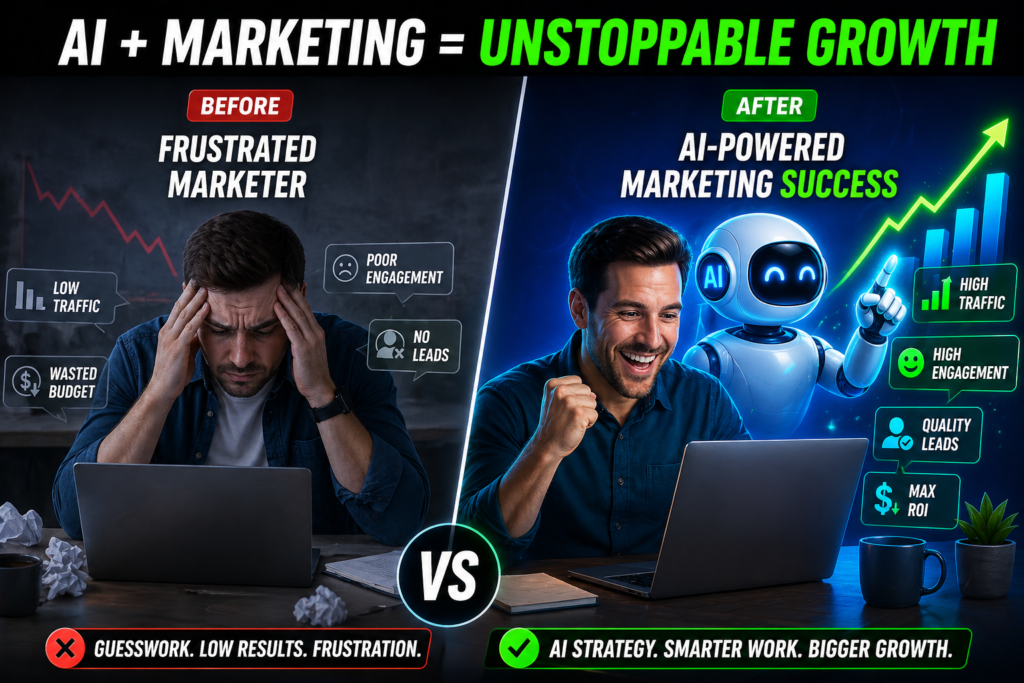
Best AI Marketing Tools 2026: Many businesses, marketers, and content creators invest significant time in marketing but still find it challenging to achieve consistent results.
- You regularly publish content on social media but struggle to increase visibility or engagement.
- Your website is live, but attracting consistent organic or referral traffic remains a challenge
- Your advertising campaigns generate clicks, but converting visitors into customers proves difficult.
And what’s the most frustrating part?
Some businesses improve their marketing efficiency by combining strategy, data analysis, and AI-powered tools.
One reason may be the effective use of AI marketing tools alongside well-planned marketing strategies.
Modern marketing often combines creativity, strategic planning, and AI-powered tools to improve efficiency and decision-making.
👉 his guide explains the fundamentals of AI marketing tools and how they can be applied in different marketing workflows.
- What are AI marketing tools?
- How do they work?
- Which are the best tools?
- How to use them (step-by-step)
- How AI marketing tools can support business growth, content creation, and marketing workflows.
Whether you’re new to AI marketing or already have experience, this guide covers the core concepts, practical use cases, and key factors to consider when choosing AI marketing tools.
How This Guide Was Prepared
This guide compares AI marketing tools based on commonly available features, usability, pricing models, and typical use cases. Since features and pricing can change, always verify the latest information on each tool’s official website.
AI marketing tools can improve efficiency, but successful marketing also depends on content quality, audience understanding, consistent execution, and ongoing optimization.
AI Marketing Tools in 2026: A Comprehensive Guide for Businesses and Creators
Artificial Intelligence (AI) has significantly changed how businesses plan, create, and optimize digital marketing campaigns over the past few years. From writing ad copy and creating social media posts to automating emails and understanding customer behavior, AI marketing tools can help businesses automate repetitive tasks, improve workflow efficiency, and support data-driven marketing decisions.
In 2026, many marketers evaluate AI tools based on their features, pricing, ease of use, and suitability for specific marketing goals.
Whether you are a blogger, entrepreneur, freelancer, agency owner, or business marketer, Whether you are a blogger, entrepreneur, freelancer, agency owner, or marketing professional, this guide explains the key features, use cases, advantages, and limitations of leading AI marketing tools to help you compare platforms and choose one that fits your requirements.
What This Guide Covers
This guide compares AI marketing tools based on commonly available features, pricing models, ease of use, automation capabilities, integrations, and typical use cases. Because AI platforms evolve quickly, features and pricing may change over time.
The suitability of an AI marketing tool depends on your goals, budget, workflow, and marketing strategy. No single platform is the best choice for every user or business.
Why Marketing Has Become More Challenging in 2026
Digital marketing continues to evolve, with increasing competition across search engines, social media platforms, and online advertising channels.
Businesses face challenges such as:
- Increasing advertising costs
- Creating content consistently
- Managing multiple social platforms
- Personalizing customer experiences
- Analyzing large amounts of data
Many marketing teams spend significant time on repetitive tasks such as scheduling content, analyzing campaign data, preparing reports, and responding to customer interactions. Automation can help streamline many of these activities.
AI marketing tools can help streamline repetitive workflows and support more efficient marketing processes.
AI marketing tools can assist with tasks such as content creation, campaign optimization, data analysis, and workflow automation, allowing marketing teams to focus more on strategy and creative work.
Keeping Pace with Algorithm Changes
Search engines and social media platforms regularly update their algorithms, requiring marketers to adjust their strategies from time to time.
Meeting User Privacy Requirements
Businesses must also consider evolving privacy regulations, cookie policies, and responsible data collection practices when planning marketing campaigns.
AI can support marketing activities, but successful campaigns also depend on clear objectives, audience research, quality content, and continuous performance analysis.
What Are AI Marketing Tools?
AI marketing tools are software applications that use artificial intelligence to support various marketing tasks, automate repetitive processes, and provide data-driven insights.
These tools can help with:
- Content creation
- Social media management
- Email marketing
- Customer engagement
- Advertising optimization
- Analytics and reporting
- Lead generation
- Search engine optimization (SEO)
- Marketing automation
- Customer segmentation
- Campaign performance analysis
- A/B testing support
Rather than replacing marketers, AI marketing tools are designed to support decision-making, automate repetitive tasks, and improve workflow efficiency while still requiring human oversight and strategic planning.
How AI Marketing Tools Work
Most AI marketing tools analyze data, identify patterns, generate content or recommendations, and automate repetitive tasks. The specific capabilities vary depending on the platform and its intended purpose.
The features available in AI marketing tools differ by platform, pricing plan, and intended use case.
Popular AI Marketing Tools in 2026
The following AI marketing tools are widely used for tasks such as content creation, marketing automation, email campaigns, advertising, social media management, and workflow automation. Each platform offers different features and is suitable for different use cases.
1. HubSpot AI
Common Use Case
Marketing automation, CRM management, lead nurturing, and customer relationship management.
Features:
- AI email writing
- CRM integration
- Lead management
- Campaign automation
Pros:
- Beginner-friendly
- Comprehensive automation features
- Excellent analytics
- Pricing: Free plan available; paid plans vary.
- Integrations: CRM, email, sales, and customer service tools.
Cons:
✘ Premium plans can be expensive
2. Jasper AI
Jasper AI is an AI writing platform commonly used for marketing and content creation.
Features:
- Blog writing
- Ad copy generation
- Email content
- Brand voice support
Common Use Case:
Marketing teams, agencies, and businesses that produce large volumes of written content
3. Copy.ai
Copy.ai provides AI-assisted tools for creating marketing content such as social media posts, product descriptions, and sales copy.
Features:
- Social media captions
- Product descriptions
- Sales copy
- Blog outlines
Common Use Case
Startups and small businesses.
4. Anyword
Anyword focuses on data-driven marketing copy.
Features:
- Predictive performance scores
- Ad copy optimization
- AI-generated content
Common Use Case:
Creating and optimizing advertising copy for digital marketing campaigns.
5. AdCreative.ai
AdCreative.ai creates ad creatives automatically.
Features:
- AI-generated ad designs
- AI-generated ad creatives designed to support advertising campaigns
- Social ad optimization
Common Use Case:
Businesses creating advertisements for platforms such as Google Ads and Meta Ads
6. Predis.ai
Predis.ai offers AI-assisted tools for creating, scheduling, and managing social media content.
Features:
- Post generation
- AI captions
- Content scheduling
7. Ocoya
Ocoya combines content creation and scheduling.
Common Use Case:
Social media content creation, scheduling, and campaign management.
8. Mailchimp AI
Mailchimp includes AI-powered features that support email personalization, audience segmentation, and campaign automation.
Features:
- Email personalization
- Audience segmentation
- Automation workflows
9. Canva AI
Canva AI includes AI-powered design features for creating presentations, marketing graphics, and social media content.
Features:
- AI image generation
- Presentation design
- Social media templates
10. Zapier AI
Zapier AI supports workflow automation by connecting compatible applications and automating repetitive tasks.
Example:
Automatically send leads from a form to your CRM.
Include the following fields for each tool:
- Pricing
- Free Plan Availability
- Supported Integrations
- Supported Languages (if applicable)
- Platform (Web/Desktop/Mobile)
- Commercial Use
- Key Limitation
Features, integrations, pricing, AI capabilities, and availability may change over time. Always check the official documentation of each platform before making a purchasing decision.
Who Is This For?
This guide is designed for anyone who wants to learn how AI marketing tools can support different marketing and content creation workflows, including:
- 🎓 Students who want to learn digital marketing, content creation, or AI-powered marketing tools.
- 📝 Bloggers looking to streamline content creation, SEO tasks, and marketing workflows.
- 🎥 Content creators and YouTubers who want to improve content planning, promotion, and audience engagement.
- 🏢 Business owners who want to automate marketing tasks, improve customer communication, and manage campaigns more efficiently.
👉 In simple words:
Whether your goal is learning AI marketing, improving productivity, or exploring automation tools, this guide provides practical information to help you compare platforms and choose solutions that match your needs.
Consider including these additional user groups:
- 📈 Digital marketers managing campaigns.
- 🏪 Small business owners with limited marketing resources.
- 💼 Freelancers and agencies handling multiple client projects.
- 🛍️ E-commerce businesses looking to automate marketing activities.
The most suitable AI marketing tool depends on your goals, budget, technical experience, and the type of marketing activities you perform.
Quick Answer
AI marketing tools are software applications that use artificial intelligence to support marketing activities such as automation, content creation, SEO, social media management, email marketing, and data analysis.
Popular AI marketing tools such as ChatGPT, Canva AI, Jasper, Copy.ai, and Surfer SEO can help automate repetitive tasks, assist with content creation, and support marketing workflows. The effectiveness of these tools depends on your strategy, implementation, and business goals.
AI marketing tools are used by businesses, marketers, agencies, and content creators to improve workflow efficiency and support data-driven decision-making across different marketing channels.
Features, pricing, integrations, and AI capabilities vary between platforms and may change over time.
What are AI Marketing Tools?
👉 Simple definition:
AI marketing tools are software applications that use artificial intelligence to assist with marketing tasks such as content creation, campaign management, data analysis, and workflow automation
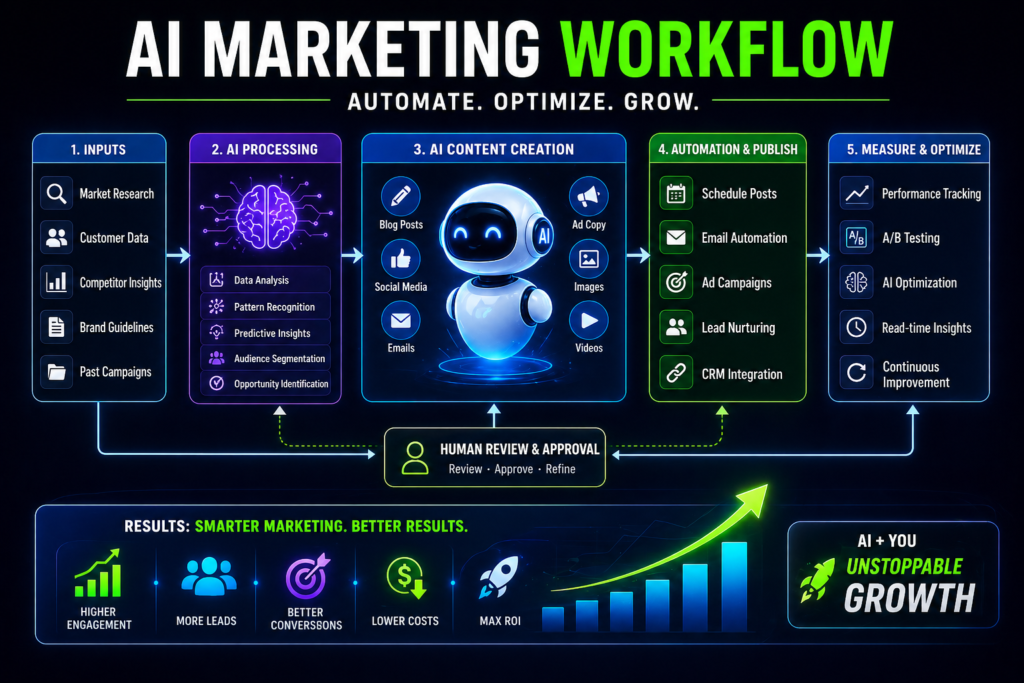
What can these tools do?
- Create content
- Suggest keywords
- Optimize ads
- Analyze audience behavior
- Manage social media
- Email marketing automation
- Customer segmentation
- Campaign reporting
- Marketing workflow automation
👉 Meaning:
These tools are designed to support marketers by automating repetitive tasks, providing recommendations, and helping improve workflow efficiency. Human review and strategic decision-making are still important.
The capabilities of AI marketing tools vary depending on the platform, pricing plan, and intended use case.
Features and Benefits of AI Marketing Tools
1. Save Time
AI marketing tools can automate repetitive tasks such as content scheduling, campaign reporting, and content generation, helping reduce the time required for routine marketing activities.
Example:
For example, AI tools can assist in drafting multiple social media posts more efficiently, although the time required depends on the platform, workflow, and level of human editing.
2. Improve Content Quality
AI tools can generate suggestions for headlines, captions, ad copy, and other marketing content based on the prompts provided and available training patterns. Human review is recommended before publishing.
3. Better Personalization
Many AI marketing platforms analyze customer data and behavior to support personalized marketing experiences, depending on the available data and platform capabilities.
When combined with an effective marketing strategy, personalization may contribute to improved user engagement and campaign performance.
4. Data-Driven Decisions
AI marketing tools can analyze campaign data and customer behavior to provide insights that support marketing decisions.
5. Increased Productivity
By automating repetitive workflows, AI marketing tools can allow teams to spend more time on strategic planning, creative work, and campaign optimization.
Improved Workflow Consistency
AI tools can help maintain consistent publishing schedules, standardized marketing processes, and organized campaign management across multiple channels.
Scalability
AI marketing tools can support businesses that manage multiple campaigns, products, or marketing channels by simplifying repetitive tasks.
The benefits of AI marketing tools depend on factors such as data quality, implementation, human oversight, and the specific platform being used.
Real-World Use Cases
For Bloggers
Bloggers commonly use AI marketing tools to support tasks such as:
- Generate content ideas
- Write newsletters
- Create social media posts
- Keyword research and SEO optimization
- Content repurposing
- Blog outline generation
For Small Businesses
Small businesses often use AI marketing tools for activities such as:
- Customer engagement
- Lead generation
- Email automation
- Customer support chatbots
- Marketing campaign scheduling
- Basic analytics and reporting
For Agencies
Marketing agencies often use AI tools to assist with managing multiple client campaigns, content creation, reporting, and workflow automation.
- Campaign reporting
- AI-assisted copywriting
- Social media scheduling
For E-commerce Stores
E-commerce businesses commonly use AI marketing tools for tasks such as:
- Product descriptions
- Personalized recommendations
- Ad optimization
- Email marketing
- Product categorization
- Customer behavior analysis
- Cart abandonment campaigns
For Digital Marketing Teams
- Campaign planning
- SEO optimization
- Performance reporting
- Competitor analysis
- Marketing automation
For Content Creators
- Video script generation
- Social media caption writing
- Thumbnail text ideas
- Content calendar planning
The features and capabilities available for each use case depend on the AI platform, subscription plan, integrations, and business requirements. Human review remains important for accuracy, branding, and compliance.
How do AI marketing tools work?
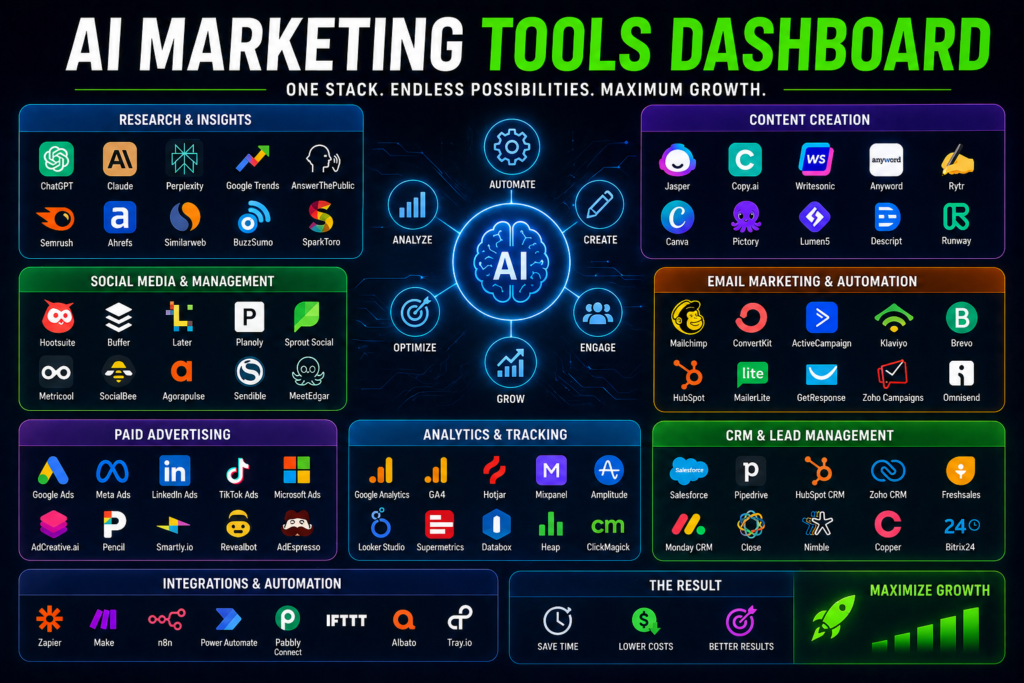
Although the exact process varies by platform, many AI marketing tools generally operate through the following three stages:
1. Data Collection
AI marketing tools collect and process data from sources such as user inputs, campaign performance, website analytics, search trends, and connected marketing platforms, depending on the tool and its permissions.
2. Data Analysis
The AI analyzes available data to identify patterns, evaluate content performance, suggest relevant keywords, and provide recommendations based on historical data or platform capabilities.
3. Smart Suggestions
Based on the analysis, the tool may suggest content ideas, headlines, keywords, publishing schedules, audience targeting, or workflow recommendations. Users should review these suggestions before implementation.
Step 4 – Human Review and Optimization
Before publishing campaigns or content, marketers should review AI-generated recommendations, verify accuracy, adjust the messaging, and ensure the content aligns with brand guidelines and legal requirements.
The data sources, AI capabilities, and recommendations provided by marketing tools vary depending on the platform, integrations, subscription plan, and user permissions.
Popular AI Marketing Tools in 2026 (Detailed Overview)
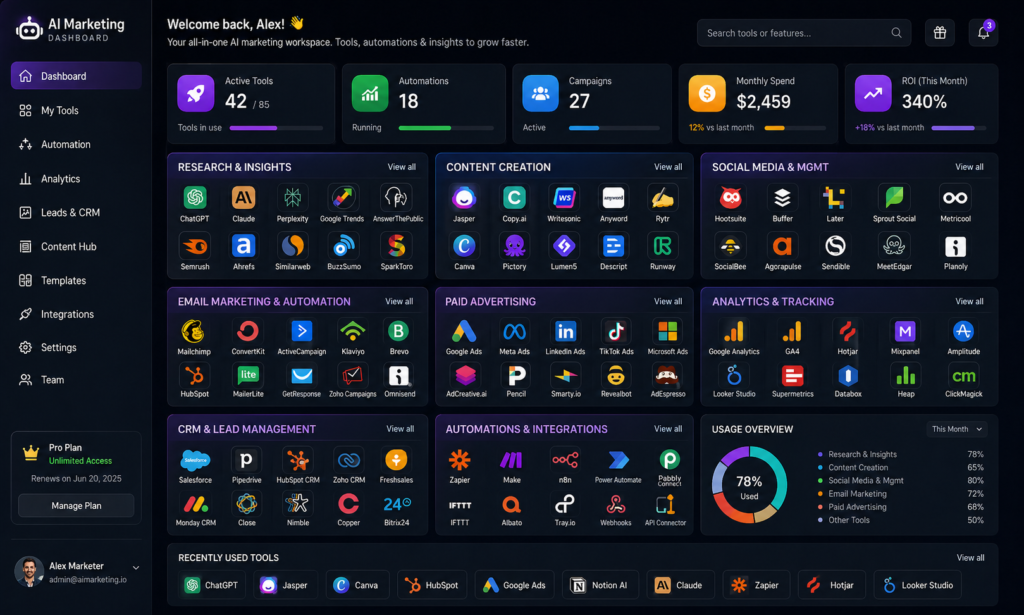
1. ChatGPT
👉 What is it?
An AI assistant that can help generate content ideas, articles, scripts, marketing copy, and other written materials based on user prompts.
⭐ Features:
- Blog writing
- YouTube script
- Ad copy
✅ Pros:
✔ Can assist with content creation and brainstorming.
✔ User-friendly interface.
✔ Supports a wide range of writing, research, and productivity tasks.
❌ Cons:
Responses may require editing for accuracy, originality, or brand-specific tone.
💡 Real Use:
Can assist in drafting blog posts, social media content, marketing emails, and campaign ideas. The final content should be reviewed and edited before publishing.
💰 Pricing:
Free plan available. Paid subscription options provide additional features and higher usage limits. Pricing may change over time. Learn more about features, pricing, and use cases.
🎨 2. Canva AI
👉 What is it?
An AI-powered design platform for creating marketing materials, presentations, social media graphics, and other visual content.
⭐ Features:
- Social media design
- AI images
- Templates
💡 Use:
Commonly used for social media graphics, advertisements, presentations, thumbnails, and promotional materials.
✍️ 3. Jasper AI
👉 What is it?
An AI writing platform designed to assist with marketing content and business copywriting.
Commonly used for advertising copy, landing pages, email campaigns, and marketing content. Read More
📢 4. Copy.ai
Supports the creation of social media posts, captions, marketing copy, and product descriptions. Learn more about features and supported use cases.
🔍 5. Surfer SEO
An AI-assisted SEO platform that helps analyze on-page content, keyword usage, and content optimization opportunities.
Include these fields for every platform:
- Common Use Case
- Key Features
- Advantages
- Limitations
- Pricing
- Free Plan Availability
- Integrations
- Supported Languages
- Platform (Web/Desktop/Mobile)
Features, pricing, AI capabilities, and availability may change over time. Always verify the latest information on the official website before selecting a tool.
Comparison Table
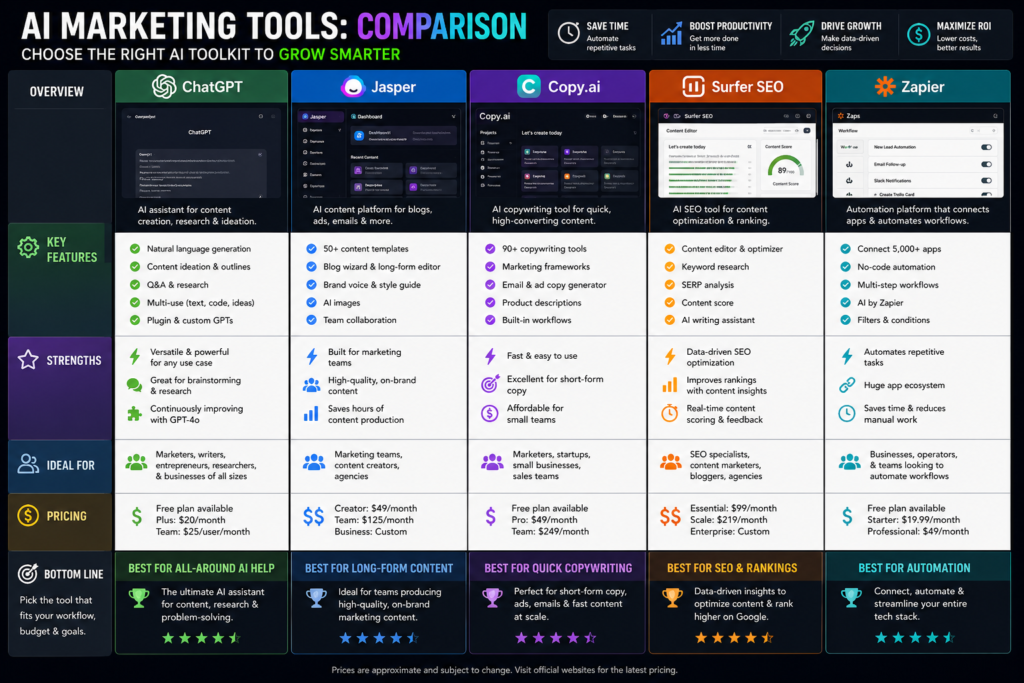
| Tool | Common Use Case | Pricing Model |
|---|---|---|
| ChatGPT | Content creation, brainstorming, and marketing copy | Free plan available + Paid plans |
| Canva AI | Graphic design, social media content, and presentations | Free plan available + Paid plans |
| Jasper AI | Marketing copywriting, advertising copy, and email campaigns | Paid (Free trial may be available) |
| Surfer SEO | SEO content optimization and on-page SEO analysis | Paid |
Step-by-Step: How to Get Started with AI Marketing
The following workflow provides a simple starting point for using AI marketing tools. Depending on your goals, business type, and preferred platforms, some steps may vary.
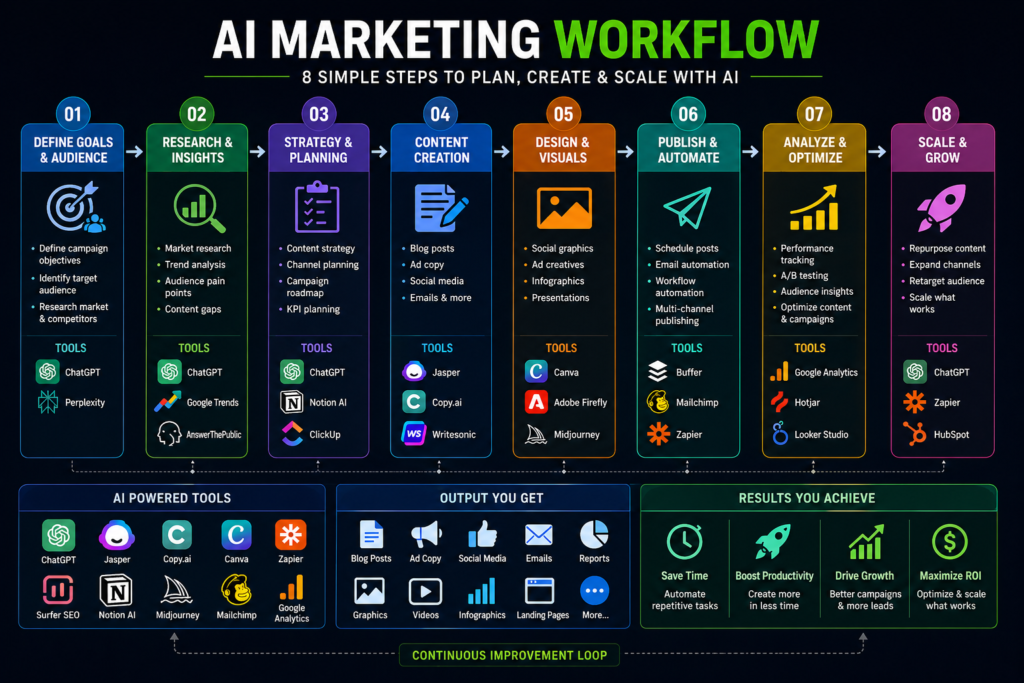
Step 1:
Conduct keyword research to identify topics, search intent, and relevant keywords for your target audienc
Step 2:
Use an AI writing tool, such as ChatGPT or a similar platform, to generate content ideas, outlines, or first drafts. Review and edit the content before publishing.
Step 3:
Create supporting visuals using an AI-powered design tool such as Canva AI or another graphic design platform.
Step 4:
Publish your content through appropriate marketing channels, such as your website, email newsletter, or social media platforms, based on your marketing strategy.
Step 5 – Review Performance
Monitor key metrics such as traffic, engagement, click-through rate, conversions, or campaign performance using analytics tools.
Step 6 – Optimize and Improve
Use performance insights to update your content, refine campaigns, test new ideas, and improve future marketing efforts.
AI marketing tools support content creation and workflow automation, but successful campaigns still depend on strategy, audience research, quality content, and ongoing optimization.
Benefits of AI Marketing Tools
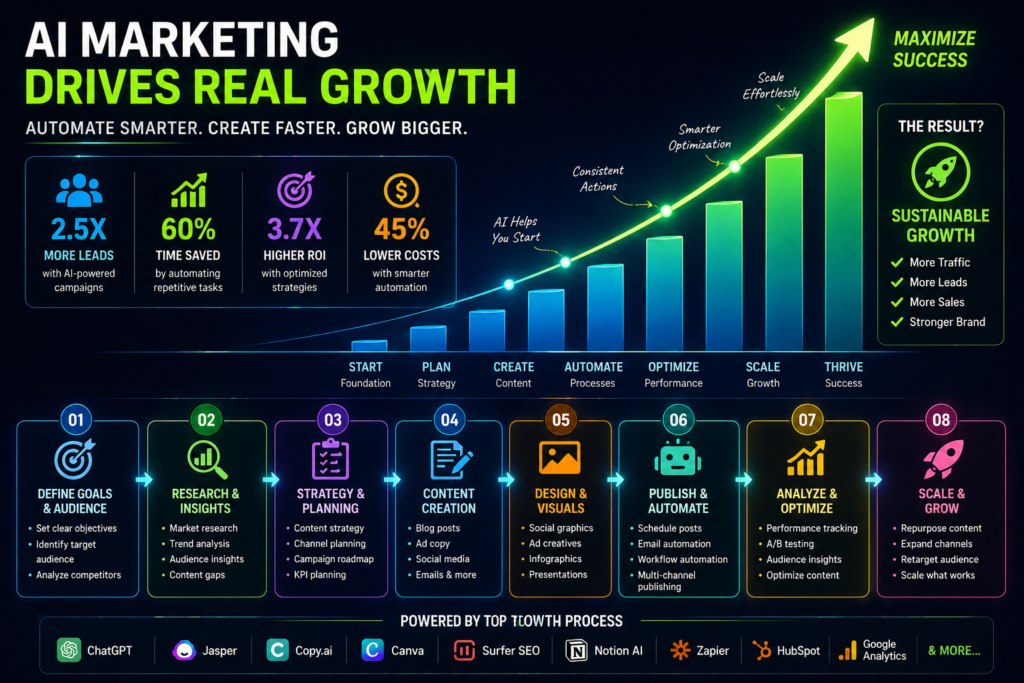
- Time Savings – AI marketing tools can automate repetitive tasks such as content drafting, campaign scheduling, and reporting, helping marketers spend more time on strategy and creative work.
- Cost Efficiency – By automating selected marketing tasks, AI tools may reduce the time and resources required for certain activities. The overall cost savings depend on the business, workflow, and subscription plan.
- Workflow Automation – AI marketing tools can automate tasks such as email campaigns, social media scheduling, reporting, and customer segmentation, helping streamline routine marketing processes.
- Improved Marketing Efficiency – When combined with a well-planned marketing strategy, AI tools can support faster content production, campaign management, and decision-making. Results vary depending on implementation and business goals.
- Better Data Insights AI tools can analyze campaign data and customer behavior to support more informed marketing decisions.
- Content Consistency AI can help maintain consistent messaging and publishing schedules across multiple marketing channels.
- Scalability AI marketing tools can assist businesses in managing larger volumes of content, campaigns, and customer interactions as operations grow.
The benefits of AI marketing tools vary depending on the platform, available data, user expertise, and overall marketing strategy. Human review remains important to ensure quality, accuracy, and brand consistency.
❌ Common Mistakes

- ❌ Publishing AI-generated content without editing or adding original insights.
- ❌ Relying entirely on AI without human review, fact-checking, or brand-specific customization.
- ❌ Ignoring search intent.
- ❌ Not fact-checking AI-generated information.
- ❌ Using outdated or inaccurate data.
- ❌ Publishing duplicate or low-value content.
- ❌ Forgetting to optimize images, metadata, and internal links.
👉 Solution:
✔ Review AI-generated content, verify facts, add original insights, and adjust the tone to match your brand before publishing.
🔥 Pro Tips
- 👉 Create comprehensive content that fully addresses the user’s search intent rather than focusing only on word count.
- 👉 Optimize content with relevant keywords, clear headings, internal links, and descriptive meta information where appropriate.
- 👉 Maintain a consistent publishing schedule and regularly update existing content to keep it accurate and relevant.
- Test different headlines and calls to action.
- Monitor content performance using analytics tools.
- Refresh evergreen articles regularly.
- Use AI as a writing assistant rather than a replacement for human expertise.
AI marketing tools are most effective when combined with human expertise, original research, and regular performance analysis.
📊 Tools Table
| Purpose | Tool | Official Website |
|---|---|---|
| Content Creation | ChatGPT | https://chatgpt.com |
| Graphic Design | Canva | https://www.canva.com |
| SEO Optimization | Surfer SEO | https://surferseo.com |
AI Marketing Tools Comparison Table
| Tool | Common Use Case | Free Plan | AI Content Generation | Workflow Automation |
|---|---|---|---|---|
| HubSpot AI | Marketing automation and CRM | Limited | Yes | Yes |
| Jasper AI | Content writing and marketing copy | Trial available | Yes | Limited |
| Copy.ai | Marketing copy and social media content | Yes | Yes | Limited |
| Mailchimp AI | Email marketing and campaign assistance | Yes | Limited | Yes |
| Canva AI | Visual content and graphic design | Yes | Limited | No |
| Zapier AI | Workflow automation and app integrations | Limited | No | Yes |
AI Marketing Tools for Instagram Growth
Growing an Instagram presence can be challenging due to increasing competition, changing algorithms, and evolving audience preferen
👉 You post daily
👉 You create Reels
👉 You use hashtags
फिर भी:
- Follower growth may be slower than expected.
- Content reach can fluctuate over time.
- Engagement levels may vary between posts.
👉 Many factors can influence Instagram performance, including content quality, audience targeting, posting consistency, and platform algorithms.
👉 AI marketing tools can support content planning, workflow automation, and performance analysis, but they are only one part of an effective Instagram strategy.
In today’s world, Instagram growth is no longer a manual process —
Many creators and businesses use AI marketing tools to streamline content creation, scheduling, analytics, and campaign management.
In this article, we will explore:
- Which AI marketing tools are commonly used for Instagram content creation and management?
- How can they support your Instagram marketing workflow and content strategy?
- And how can they drive rapid growth?
No AI marketing tool can guarantee follower growth, higher engagement, or increased reach. Success depends on content quality, audience relevance, consistency, and Instagram’s evolving algorithms.
Briefly explain what the guide will cover, such as:
- AI tools for content creation
- AI design tools
- Caption and hashtag generation
- Scheduling and automation
- Analytics and performance tracking
- Best practices for responsible AI use
Quick Answer
AI marketing tools for Instagram are software applications that assist with tasks such as content creation, caption generation, hashtag suggestions, post scheduling, analytics, and workflow automation. Features vary by platform.
These tools can help streamline content creation, improve workflow efficiency, and support data-driven marketing decisions. Their effectiveness depends on factors such as content quality, audience relevance, posting consistency, and Instagram’s algorithms.
AI marketing tools support your workflow but do not guarantee follower growth, higher engagement, or increased reach. Results vary depending on your strategy, audience, and platform updates.
How do AI marketing tools help with Instagram growth?
AI marketing tools can assist with several common Instagram marketing tasks, including:
- Generating content ideas
- Writing captions
- Finding the right hashtags
- Scheduling posts
- Analyzing performance
👉 Meaning:
These tools can help streamline your Instagram workflow by assisting with content planning, publishing, and performance analysis. Human creativity, strategy, and review remain important for achieving meaningful results.
Additional common AI-assisted Instagram tasks:
- Content calendar planning
- Audience insights
- Post-performance reporting
- Image and design assistance
- Content repurposing
- Caption variation generation
The features available depend on the AI platform, connected applications, and subscription plan. AI tools support Instagram marketing but do not guarantee increased reach, engagement, or follower growth.
Popular AI Marketing Tools for Instagram Management and Content Creation
🧠 1. ChatGPT
👉 What is it?
An AI assistant that helps generate caption ideas, content outlines, scripts, and marketing copy based on user prompts.
⭐ Features:
- Caption generation
- Reel content ideas
- Opening hook suggestions
- Content brainstorming
💡 Use Case:
Example Prompt: “Write an Instagram caption for a motivational Reel.” The AI can generate a draft that should be reviewed and customized before publishing.
💰 Pricing:
Free plan available. Paid subscription options provide additional features and usage limits.
🎨 2. Canva AI
👉 What is it?
An AI-powered design platform for creating Instagram posts, Reel covers, stories, and other visual marketing assets.
⭐ Features:
- Templates
- AI image generator
- Post design
💡 Use Case:
Can assist in creating professional-looking social media designs using templates and AI-assisted design features.
📢 3. Copy.ai
👉 What is it?
An AI writing platform for generating marketing copy, captions, product descriptions, and promotional content.
⭐ Features:
- Captions
- Product promotion text
- Ads content
📊 4. Predis.ai
👉 What is it?
An AI-powered social media management platform with features designed to support Instagram content planning and publishing.
⭐ Features:
- Auto post generation
- Caption + hashtags
- Scheduling
Predis.ai includes features that support Instagram content creation, scheduling, caption generation, and hashtag suggestions.
📅 5. Buffer AI
👉 What is it?
A social media management platform that includes scheduling and content management features for multiple social media platforms.
⭐ include these fields consistently:
- Common Use Case
- Advantages
- Limitations
- Free Plan Availability
- Pricing
- Supported Platforms
- Integrations
Features, pricing, integrations, and AI capabilities vary by platform and may change over time. These tools support Instagram content creation and management but do not guarantee increased reach, engagement, or follower growth.
📊 Comparison Table
| Tool | Common Use Case | Pricing Model |
|---|---|---|
| ChatGPT | Caption writing, content ideas, and script generation | Free plan available + Paid plans |
| Canva AI | Instagram post design, Reel covers, and visual content | Free plan available + Paid plans |
| Predis.ai | Social media content planning, caption generation, scheduling, and analytics | Paid (Free trial or limited free plan may be available) |
| Buffer | Social media scheduling, publishing, and performance tracking | Free plan available + Paid plans |
Step-by-Step: AI-Assisted Instagram Marketing Workflow
The following workflow illustrates one way to use AI marketing tools for Instagram content creation and management. The tools you choose may vary based on your workflow, budget, and business needs.
Step 1:
Use an AI writing assistant, such as ChatGPT or a similar tool, to brainstorm content ideas, campaign themes, or Reel concepts.
Step 2:
Create visual content using an AI-powered design platform such as Canva AI or another graphic design tool.
Step 3:
Use an AI writing tool to generate caption ideas, calls to action, or promotional copy, then review and customize the content before publishing.
Step 4:
Use a social media management platform to generate hashtag suggestions and schedule posts for consistent publishing.
Step 5:
Monitor engagement, reach, and other performance metrics using analytics tools provided by your social media management platform.
Step 6 – Review and Optimize
Regularly analyze your content performance, identify successful posts, update your strategy, and test new ideas to improve future campaigns.
AI tools can simplify content creation, scheduling, and analysis, but successful Instagram marketing also depends on content quality, audience understanding, consistency, and platform best practices.
Benefits of AI Tools
- Time Savings – AI tools can automate repetitive tasks such as caption drafting, content planning, and scheduling, helping reduce the time spent on routine activities.
- Content Consistency – AI tools can help maintain a regular publishing schedule and consistent messaging across your Instagram content.
- Supports Audience Engagement – AI tools can help optimize captions, hashtags, and posting schedules, which may contribute to improved engagement when combined with a strong content strategy.
- Improved Workflow Efficiency – AI tools can streamline content creation and campaign management, allowing creators to focus more on strategy and audience engagement.
- Better content planning
- Workflow automation
- Performance insights
- Content repurposing
- Improved team collaboration
❌ Common Mistakes
- ❌ Publishing AI-generated content without editing or adding original insights.
- ❌ Using irrelevant or overly broad hashtags that do not match the content or audience.
- ❌ Posting inconsistently without a planned content schedule.
- ❌Ignoring Instagram analytics
- ❌Not testing different content formats
- ❌Overusing automation
- ❌Failing to review AI-generated content for accuracy
👉 Solution:
Use AI to assist with content creation, but combine its suggestions with human creativity, fact-checking, and brand-specific customization before publishing.
AI tools can simplify Instagram content creation and management, but long-term success depends on content quality, audience understanding, consistency, and continuous optimization.
🔥 Pro Tips (Expert Level)
👉 Write a clear and engaging opening that encourages viewers to continue watching or reading.
👉 Capture attention early with a relevant opening, clear visuals, or an engaging message.
👉 Use relevant audio, visual elements, and content formats that align with current platform trends and your audience.
👉 Maintain a consistent publishing schedule that you can sustain over time.
📈 Practical Workflow Tip
👉 Use this formula:
High-quality content + Consistent publishing + AI-assisted workflows + Performance analysis can support a more efficient Instagram marketing strategy.
AI tools can simplify many aspects of Instagram marketing, but long-term success also depends on content quality, audience understanding, creativity, and consistent optimization.
👉 If you’re new to AI marketing, consider starting with one or two tools for content creation and design. As your workflow evolves, you can explore additional tools for scheduling, analytics, and automation.
Expand your toolkit gradually based on your marketing goals, budget, and workflow requirements.
👉 Final Line:
“AI marketing tools can help improve efficiency and support your Instagram workflow, but sustainable growth depends on valuable content, audience engagement, and consistent improvement.”
AI should be viewed as a productivity tool rather than a replacement for creativity, strategy, or audience engagement. Regular testing, analytics, and continuous learning remain essential for long-term success.
Best Practices for Using AI Marketing Tools
To get the best results:
✔ Review AI-generated content
✔ Maintain your brand voice
✔ Fact-check important information
✔ Use original visuals
✔ Monitor campaign performance
✔ Prioritize customer experience
Use AI to support content creation, workflow automation, and data analysis while maintaining human oversight, creativity, and strategic decision-making
Conclusion
AI marketing tools have become a common part of modern marketing workflows across many industries.
Exploring AI marketing tools can help businesses and creators streamline workflows, improve efficiency, and evaluate new approaches to content creation and campaign management.
👉 If you’re new to AI marketing, start with one or two tools that match your goals, then gradually explore additional platforms as your workflow evolves.
The right AI marketing tool depends on your business goals, content strategy, budget, and workflow. Evaluate different platforms, test their features, and choose the solutions that best fit your long-term marketing objectives.
AI marketing tools can improve efficiency and simplify many tasks, but successful marketing campaigns still require human creativity, strategic planning, audience research, and ongoing performance analysis.
❓ FAQs
Q1. Which AI tools are commonly used for Instagram marketing?
Popular options include ChatGPT for content ideas and captions, Canva AI for visual design, and other tools for scheduling and analytics. The right choice depends on your workflow and marketing goals.
Q2: Are there free AI marketing tools available?
Yes. Many AI marketing platforms offer free plans or limited free features. Premium subscriptions typically provide additional capabilities and higher usage limits.
Q3: How long does it take to see results from AI marketing tools?
There is no fixed timeline. Results depend on factors such as content quality, audience relevance, posting consistency, competition, and overall marketing strategy.
Q: Can AI marketing tools replace human marketers?
No. AI tools assist with content creation, automation, and analysis, but human creativity, strategic planning, and decision-making remain essential.
Q: Do AI marketing tools guarantee more followers or engagement?
No. AI tools can improve workflow efficiency and support marketing efforts, but results depend on content quality, audience engagement, consistency, and platform algorithms.
Are AI-generated captions safe to publish without editing?
It is recommended to review and edit AI-generated content to ensure accuracy, originality, and alignment with your brand voice.