
Explore AI Tools
Artificial intelligence is increasingly being used across industries to support tasks such as content creation, software development, design, learning, research, and business operations. Whether you are a student, blogger, marketer, developer, designer, or entrepreneur, AI tools can help automate repetitive tasks and support productivity, depending on how they are implemented and the specific workflow.
This guide explores a wide range of free and paid AI tools available in 2026, highlighting their primary features, common use cases, and suitability for different users. The guide includes AI tools for writing, image generation, coding, productivity, marketing, design, education, and other common use cases, with information suitable for both beginners and experienced users.
If you’re comparing AI tools or exploring options for different tasks, this guide provides an organised overview to help you evaluate available platforms.
based on factors such as:
- Features and capabilities
- Common use cases
- Ease of use
- Popularity and industry adoption
- Availability of free or paid plans
- Overall suitability for different user groups
The tools included in this guide are provided for informational purposes and are not ranked in order of quality or performance unless explicitly stated. Features, pricing, availability, and AI capabilities may change over time. Always review the official documentation before selecting a tool.
Why are AI tools more important than ever in 2026?
Artificial intelligence is increasingly being adopted across many industries and consumer applications. Organisations and individuals use AI to support a wide range of digital tasks and workflows. Businesses often use AI for workflow automation, content creators may use it to assist with content production, and developers commonly use AI-powered coding tools to support software development.
The Growing Problem
Common challenges that AI tools may help address include:
Many people struggle with:
- Spending too much time on repetitive tasks
- Creating content regularly
- Designing graphics without technical skills
- Editing videos manually
- Managing business operations efficiently
AI tools can assist with many of these tasks by providing automation, content suggestions, analysis, and workflow support.
Depending on the task and the tool used, AI can reduce the time required for certain repetitive or data-intensive activities. The level of improvement varies based on the workflow, user expertise, and the capabilities of the platform.
Examples of Common AI Use Cases
examples such as:
- Writing and editing
- Image generation
- Video editing
- Coding assistance
- Customer support
- Data analysis
- Marketing automation
- Research and summarisation
AI tools can improve efficiency for many tasks, but their effectiveness depends on the specific tool, the quality of the input, and human review. They should be used to support—not replace—critical thinking, professional judgement, and domain expertise.
Categories of AI Tools in 2026
To help readers compare AI tools more easily, this guide groups them into categories based on their primary functions and common use cases.
1. AI Writing Tools
AI writing tools can assist with tasks such as drafting articles, emails, social media content, marketing copy, and other text-based workflows. Human review and editing remain important before publishing.
Popular AI Writing Tools
1. ChatGPT
Common Use Cases: Content drafting, brainstorming, coding assistance, research support, and general productivity tasks
Features:
- Article writing
- Research assistance
- Translation
- Code generation
- Responses depend on prompts and available model capabilities.
- Human review is recommended for factual accuracy.
Pros:
- Easy to use
- Multi-purpose
- Can generate responses quickly for many common tasks
Cons:
- Some advanced models, features, or usage limits may require a paid subscription, depending on the platform and plan.
2. Claude
Best for:
- Long-form writing
- Research tasks
- Document analysis
- Key strengths
- Supported document types
- Availability of free and paid plans
3. Jasper AI
Common Use Cases: Marketing content creation, campaign copy, and AI-assisted content workflows
- Marketing teams
- SEO content generation
4. Copy.ai
Common Use Cases: Advertising copy, product descriptions, and social media conten
5. Writesonic
Common Use Cases: Blog drafting, AI-assisted writing, and content optimisation support
fields such as:
- Platform (Web, Desktop, Mobile)
- Free Plan Availability
- Paid Plans
- Primary Features
- Typical Users (Beginners, Professionals, Teams)
- Integrations
- Supported Languages
How These Tools Were Selected
based on factors such as:
- Common use cases
- Feature availability
- Industry adoption
- Ease of use
- AI capabilities
- Availability in 2026
The tools listed are provided for informational purposes and are not ranked by quality or performance. Features, pricing, AI capabilities, and availability may change over time. Always refer to the official documentation before selecting a platform. AI-generated content should be reviewed for accuracy, originality, and compliance with applicable policies before publication.
2. AI Image Generation Tools
AI image generation tools are widely used for creating illustrations, concept art, marketing visuals, product images, and other creative content.
Popular AI Image Generation Tools
6. Midjourney
Supports the generation of artistic and photorealistic images from text prompts.
7. DALL·E
Generates images from natural language prompts with support for a variety of creative styles and concepts.
8. Leonardo AI
Commonly used for game assets, concept art, and creative design workflows.
9. Adobe Firefly
Designed to integrate with Adobe Creative Cloud applications and creative workflows.
10. Ideogram
Designed to generate images that include readable and stylised text, depending on the prompt and model capabilities.
details such as:
- Common Use Cases
- Free Plan Availability
- Paid Plans
- Image Styles Supported
- Editing Features
- Commercial Use Policy
- Platform Availability (Web/Desktop/Mobile)
Selection Criteria
based on factors such as:
- Common use cases
- Feature set
- Ease of use
- Industry adoption
- Availability in 2026
- Free and paid options
Features, pricing, supported models, image quality, and licensing terms may change over time. Always review the official documentation and licensing policies before using AI-generated images for commercial or professional purposes.
3. AI Video Tools
Many video creators use AI tools to assist with editing, animation, scripting, voice generation, and other video production tasks. The amount of time saved depends on the project complexity and the capabilities of the selected tool.
Popular AI Video Creation Tools
11. Runway
Common Features:
- AI-assisted video editing
- Background removal tools
- Motion and visual effects
12. Pika Labs
Supports the creation of AI-generated videos from text prompts, depending on the selected model and available features.
13. Synthesia
Supports the creation of presenter-style videos using AI-generated avatars and voice options.
14. HeyGen
Provides AI-generated avatars that can present scripted content in multiple supported languages and voices.
15. InVideo AI
Assists with converting written scripts into video drafts using AI-supported editing and media generation features. Human review and editing may still be required.
fields such as:
- Common Use Cases
- Free Plan Availability
- Paid Plans
- AI Avatars (Yes/No)
- Voice Generation
- Video Editing Features
- Export Options
- Supported Languages
- Commercial Use Policy
How These Tools Were Selected
selected based on:
- Common use cases
- Feature availability
- Ease of use
- Industry adoption
- AI capabilities
- Availability in 2026
Features, pricing, AI models, export options, and licensing terms may change over time. Always review the official documentation before selecting a platform. AI-generated videos should be reviewed for accuracy, quality, copyright compliance, and suitability before publication.
4. AI Voice Tools
AI voice tools are widely used to support content creation, accessibility, education, customer service, and multimedia production through text-to-speech and AI-generated voice technologies.
Popular AI Voice Tools
16. ElevenLabs
Supports AI voice generation and voice cloning features, subject to the platform’s available capabilities and usage policies.
17. Murf AI
Provides AI-generated voiceovers for presentations, training materials, videos, and other multimedia projects.
18. PlayHT
Offers text-to-speech functionality with AI-generated voices for a variety of content formats.
19. Speechify
Converts written text into spoken audio using AI-supported text-to-speech technology.
20. Resemble AI
Supports custom AI voice creation and voice synthesis features, depending on the selected plan and available capabilities.
fields such as:
- Common Use Cases
- Free Plan Availability
- Paid Plans
- Voice Cloning Support
- Text-to-Speech Support
- Language Support
- API Availability
- Commercial Use Policy
Responsible Use of AI Voices
points such as:
- Obtain permission before cloning a person’s voice.
- Follow copyright and licensing requirements.
- Clearly disclose AI-generated voices where appropriate.
- Avoid deceptive or misleading use of synthetic voices.
Features, pricing, voice models, supported languages, and licensing terms may change over time. Always review the official documentation and applicable legal requirements before using AI-generated or cloned voices for commercial or public content.
5. AI Coding Tools
Many developers use AI coding tools to assist with code generation, debugging, documentation, code completion, and software development workflows. The benefits depend on the project, programming language, and how the tools are used.
Popular AI Coding Assistants
21. GitHub Copilot
Provides AI-assisted code suggestions, code completion, and programming support within compatible development environments.
22. Cursor
Code editor with integrated AI features that assist with writing, editing, explaining, and reviewing code.
23. Replit AI
Provides AI-assisted coding features within a browser-based development environment.
24. Tabnine
Offers AI-assisted code completion and development suggestions across supported programming languages and IDEs.
25. Codeium
Offers AI-assisted coding features, including free options for eligible users, subject to the platform’s current plans and licensing.
fields such as:
- Common Use Cases
- Supported Programming Languages
- IDE Integrations
- Free Plan Availability
- Paid Plans
- Code Completion
- Code Explanation
- Debugging Assistance
- Documentation Support
- API Availability
Using AI Coding Tools Responsibly
points such as:
- Review AI-generated code before deployment.
- Test generated code for correctness and security.
- Follow software licensing requirements.
- Avoid exposing sensitive or proprietary code when using cloud-based AI services.
Features, pricing, supported programming languages, IDE integrations, and AI capabilities may change over time. AI-generated code should always be reviewed, tested, and validated before use in production environments.
6. AI Productivity Tools
AI productivity tools assist with organising information, managing tasks, improving writing, scheduling activities, and automating repetitive workflows. Their effectiveness depends on the user’s workflow and the platform’s capabilities.
Popular AI Productivity Tools
26. Notion AI
Supports note-taking, content drafting, summarisation, and workspace organisation using AI-assisted features.
27. Grammarly
Provides grammar checking, spelling suggestions, writing feedback, and style recommendations.
28. Otter.ai
Supports AI-assisted meeting transcription and conversation summaries, depending on the available features.
29. Fireflies.ai
Provides meeting transcription, summaries, searchable notes, and collaboration features where supported.
30. Motion
Supports AI-assisted scheduling, task planning, and calendar management features.
fields such as:
- Common Use Cases
- Free Plan Availability
- Paid Plans
- Platform Availability (Web/Desktop/Mobile)
- Integrations
- Collaboration Features
- AI Features
- Supported Languages
Why These Tools Were Included
tools were selected based on:
- Common workplace use cases
- Productivity features
- Ease of use
- Industry adoption
- AI capabilities
- Availability in 2026
Features, pricing, integrations, AI capabilities, and supported platforms may change over time. Always review the official documentation before selecting a productivity tool. AI-generated summaries, schedules, and writing suggestions should be reviewed for accuracy before use.
AI Research Tools in 2026: A Comprehensive Guide
This guide explores AI research tools available in 2026 and their common use cases. Finding reliable information from multiple online sources can require significant time and careful evaluation. That’s where AI Research Tools come in. AI research tools can assist with tasks such as information gathering, document summarisation, source discovery, literature review, and research organisation. The quality of the results depends on the tool, the available data, and human verification.
👉 These tools may be useful for students, researchers, content creators, educators, marketers, and professionals who regularly work with large amounts of information, These AI research tools can help streamline research workflows and organise information more efficiently, depending on the task and the platform used. The following section provides an overview of AI research tools, including their primary features, common use cases, and available plans where applicable.
How These Research Tools Were Selected
criteria such as:
- Research capabilities
- Source discovery features
- Summarisation quality
- Citation support
- Ease of use
- Availability of free and paid plans
- Industry adoption
AI research tools assist with information gathering and analysis but should not replace critical thinking or independent source verification. Always verify important facts, citations, and references using authoritative sources before relying on AI-generated outputs. Features and pricing may change over time.
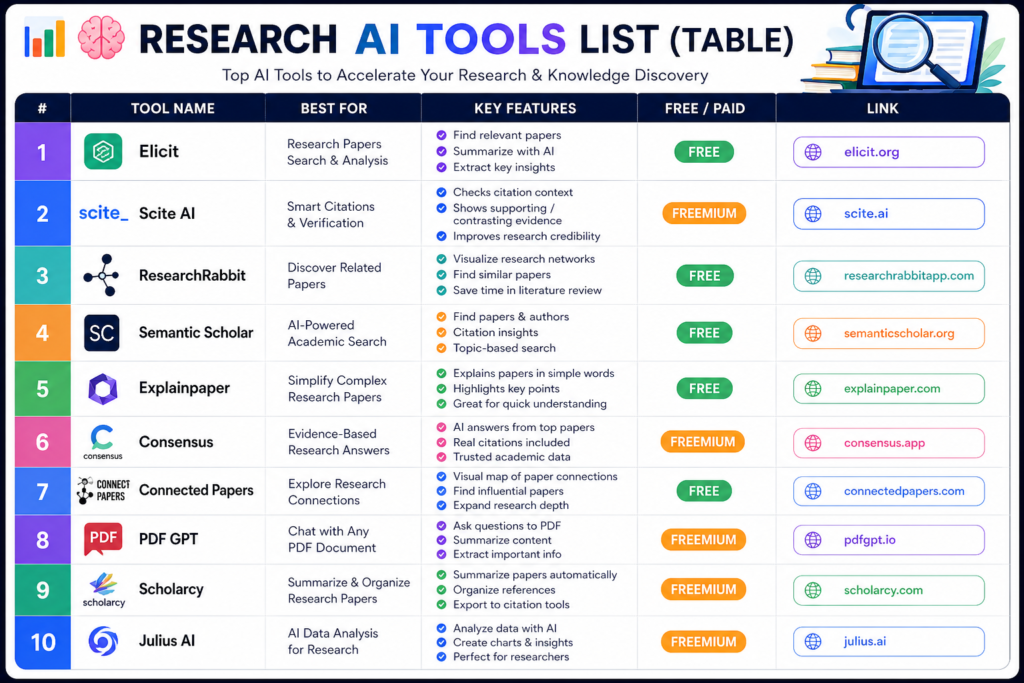
📊 🧠 Research AI Tools List (Table)
| Tool Name | Common Use Cases | Pricing Model | Official Website |
|---|---|---|---|
| ChatGPT | Content, Ideas & Explanation | Free plan available | Official Website |
| Perplexity AI | Deep Research & Sources | Free & Paid plans | Official Website |
| Elicit | Academic Research | Free & Paid plans | Official Website |
| Scite AI | Research Papers Analysis | Paid plans available | Official Website |
| Consensus | Scientific Answers | Free & Paid plans | Official Website |
| Research Rabbit | Paper Discovery | Free & Paid plans | Official Website |
| Connected Papers | Research Mapping | Free & Paid plans | Official Website |
| Scholarcy | Article Summary | Free & Paid plans | Official Website |
| TLDR | Quick Summaries | Free & Paid plans | Official Website |
| Gimme Summary | Web Page Summary | Free & Paid plans | Official Website |
| Humata AI | PDF Analysis | Free & Paid plans | Official Website |
| Iris AI | Scientific Research | Paid plans available | Official Website |
| Petal | Academic Search | Free & Paid plans | Official Website |
| Semantic Scholar | Research Papers | Free & Paid plans | Official Website |
| Explainpaper | Paper Explanation | Free & Paid plans | Official Website |
Consider expanding the table with:
- Platform (Web/Desktop/Mobile)
- Primary Function
- AI Features
- Citation Support
- PDF Support
- Browser Extension (Yes/No)
- API Availability
- Registration Required
- Free Plan Availability
How These Tools Were Selected
selected based on:
- Research-related capabilities
- Academic and professional use cases
- Feature availability
- Ease of use
- Industry adoption
- Availability in 2026
Features, pricing, AI models, supported integrations, and licensing terms may change over time. Always verify the latest information on each tool’s official website before making a decision. AI-generated research results should be independently verified using authoritative sources.
Popular AI SEO Tools in 2026
AI SEO Tools in 2026: A Comprehensive Guide
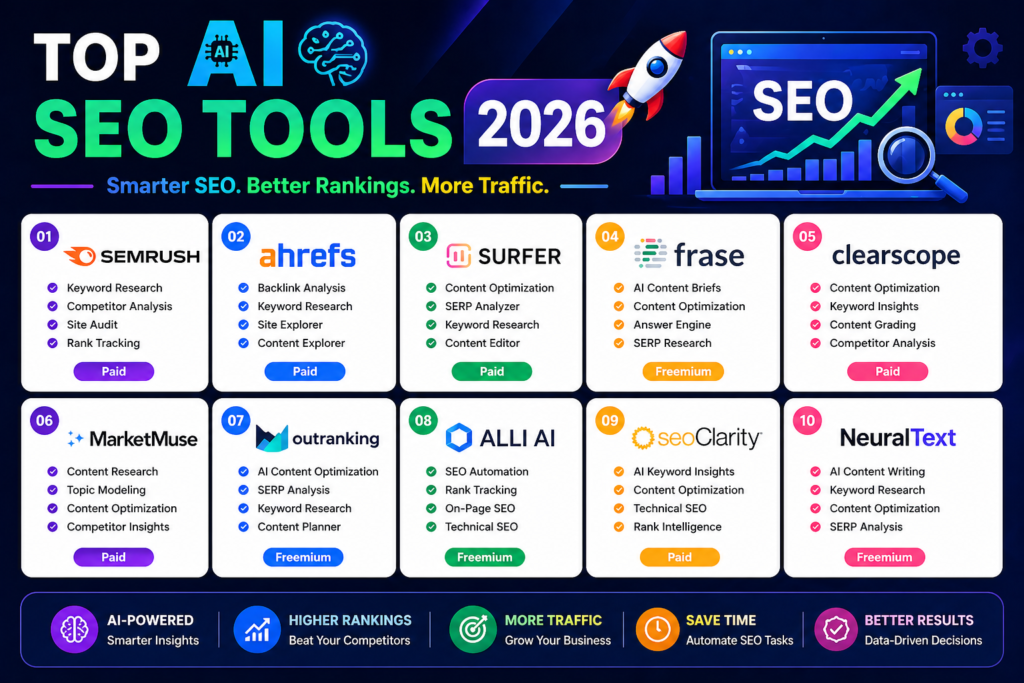
Achieving and maintaining search visibility requires consistent SEO practices, high-quality content, technical optimisation, and an understanding of user intent. Search competition varies across industries, and improving organic visibility typically requires a combination of content quality, technical SEO, backlinks, and ongoing optimisation. This guide explores AI SEO tools available in 2026 and their common use cases.
This is where AI SEO tools come in handy. AI SEO tools can assist with keyword research, content optimisation, technical SEO analysis, rank monitoring, and workflow automation. Their effectiveness depends on how they are used alongside broader SEO best practices.
These tools may be useful for bloggers, freelancers, marketers, agencies, and business owners looking to support their SEO workflows. Results depend on factors such as content quality, technical implementation, competition, backlinks, search intent, and ongoing optimisation.
How These AI SEO Tools Were Selected
criteria such as:
- SEO feature set
- Keyword research capabilities
- Content optimisation tools
- Technical SEO support
- Ease of use
- Industry adoption
- Free and paid plan availability
- Availability in 2026
AI SEO tools can support research, optimisation, and workflow efficiency, but they do not guarantee higher rankings or increased traffic. Search performance depends on multiple factors, including content quality, technical SEO, backlinks, user intent, website authority, and search engine algorithms. Features and pricing may change over time.
SEO Tools List (Table)
AI SEO tools can assist with keyword research, content optimisation, technical SEO analysis, backlink research, and performance monitoring. Their effectiveness depends on how they are used as part of a broader SEO strategy.
| Tool Name | Common Use Cases | Pricing Model | Official Website |
|---|---|---|---|
| Ahrefs | Keyword research and backlink analysis | Paid plans available | 🔗 Official Website |
| SEMrush | SEO research and competitor insights | Paid plans available | 🔗 Official Website |
| Surfer SEO | Content optimisation and on-page SEO recommendations | Paid plans available | 🔗 Official Website |
| RankMath | WordPress SEO management and optimisation | Free & Paid plans | 🔗 Official Website |
Note: The most suitable SEO tool depends on your objectives, budget, workflow, website size, and required features. Compare capabilities, integrations, and pricing before making a decision.
comparison fields such as:
- Primary Function
- Supported Platforms
- Free Trial Availability
- API Access
- Backlink Analysis
- Rank Tracking
- Technical SEO Audit
- Content Optimisation
- Team Collaboration
How These SEO Tools Were Selected
criteria such as:
- SEO feature set
- Keyword research capabilities
- Technical SEO support
- Content optimisation features
- Ease of use
- Industry adoption
- Availability in 2026
Features, pricing, integrations, and AI capabilities may change over time. AI SEO tools support optimisation workflows but do not guarantee higher search rankings or increased organic traffic. SEO performance depends on factors such as content quality, technical implementation, backlinks, user intent, website authority, and search engine algorithms.
Popular AI Marketing Tools in 2026
AI Marketing Tools in 2026: A Comprehensive Guide

Modern digital marketing includes activities such as content creation, search engine optimisation, social media management, email marketing, advertising, and campaign analysis. Many organisations use AI tools to support these workflows.
AI marketing tools can assist with tasks such as content creation, campaign planning, ad optimisation, social media management, audience analysis, and marketing automation. Their effectiveness depends on the selected platform, data quality, and overall marketing strategy.
These tools may be useful for business owners, freelancers, marketing teams, agencies, and digital marketers looking to support their marketing workflows and improve operational efficiency.
The following section provides an overview of AI marketing tools, their primary features, common use cases, and available plans where applicable.
How These AI Marketing Tools Were Selected
criteria such as:
- Marketing capabilities
- Automation features
- Content creation support
- Analytics and reporting
- Integration options
- Ease of use
- Industry adoption
- Availability in 2026
AI marketing tools can support content creation, campaign management, and workflow automation, but they do not guarantee improved campaign performance, higher conversions, increased sales, or business growth. Results depend on factors such as marketing strategy, audience targeting, content quality, budget, competition, and platform algorithms. Features and pricing may change over time.
AI Marketing Tools List (Table)
| Tool Name | Common Use Cases | Pricing Model | Official Website |
|---|---|---|---|
| Jasper AI | AI-assisted marketing content creation | Paid plans available | 🔗 Official Website |
| Copy.ai | Ad copy generation | Free & Paid plans | 🔗 Official Website |
| Writesonic | AI Content & Marketing Copy | Free & Paid plans | 🔗 Official Website |
| AdCreative AI | Ad Creatives & Campaigns | Paid plans available | 🔗 Official Website |
| Predis AI | Social media content planning | Free & Paid plans | 🔗 Official Website |
| Ocoya | Social Media Marketing Automation | Paid plans available | 🔗 Official Website |
| Smartly.io | Campaign management | Paid plans available | 🔗 Official Website |
| HubSpot AI | Marketing automation | Free & Paid plans | 🔗 Official Website |
| Phrasee | Email marketing optimisation | Paid plans available | 🔗 Official Website |
| Pencil AI | Ad Creative Generation | Paid plans available | 🔗 Official Website |
Note: The most suitable marketing tool depends on your objectives, budget, existing technology stack, required integrations, team workflow, and preferred features. Compare available capabilities before selecting a platform.
comparison fields such as:
- Primary Function
- Supported Platforms
- AI Features
- Integrations
- CRM Support
- Social Media Support
- Email Marketing Support
- Analytics & Reporting
- API Availability
- Free Trial Availability
How These AI Marketing Tools Were Selected
criteria such as:
- Marketing capabilities
- Content creation features
- Automation functionality
- Integration options
- Analytics features
- Ease of use
- Industry adoption
- Availability in 2026
Features, pricing, AI capabilities, integrations, and licensing terms may change over time. AI marketing tools can support content creation, campaign management, and workflow automation, but they do not guarantee improved campaign performance, increased conversions, higher sales, or business growth. Always review the latest information on each tool’s official website before making a decision.
Popular AI Video Tools in 2026
AI Video Tools in 2026: A Comprehensive Guide

Video content is widely used across platforms for education, marketing, entertainment, and communication. Creating videos often involves scripting, editing, media production, and review, which can require significant time depending on the project’s complexity.
AI video tools can assist with tasks such as script generation, text-to-video creation, video editing, caption generation, voice synthesis, and workflow automation. The available features and output quality depend on the selected platform and may require human review and editing. The following section compares AI video tools, their primary features, common use cases, and available plans where applicable.
These tools may be useful for YouTubers, educators, marketers, businesses, and content creators looking to support different stages of the video production workflow.
How These AI Video Tools Were Selected
criteria such as:
- Video creation capabilities
- Editing features
- Text-to-video support
- AI avatar and voice features
- Ease of use
- Export options
- Industry adoption
- Availability in 2026
eatures, pricing, export options, AI models, and licensing terms may change over time. AI video tools can assist with content creation and editing but do not guarantee production quality, audience engagement, or platform performance. Always review AI-generated videos for accuracy, copyright compliance, and suitability before publishing.
Video AI Tools List (Table)
| Tool Name | Common Use Cases | Pricing Model | Official Website |
|---|---|---|---|
| Runway ML | AI-assisted video editing | Free/Paid | 🔗 Official Website |
| Pika Labs | Text-to-video generation | Free | 🔗 Official Website |
| Synthesia | AI avatar video creation | Paid | 🔗 Official Website |
| HeyGen | Talking AI Videos | Paid | 🔗 Official Website |
| InVideo AI | AI presentation videos | Free/Paid | 🔗 Official Website |
| Veed.io | Online Video Editing | Free/Paid | 🔗 Official Website |
| Descript | Video + Audio Editing | Free/Paid | 🔗 Official Website |
| Lumen5 | Marketing Videos | Free/Paid | 🔗 Official Website |
| Fliki | Text to Video & Voice | Free/Paid | 🔗 Official Website |
| Elai.io | AI Presenter Videos | Paid | 🔗 Official Website |
Note: The most suitable video AI tool depends on your experience level, content type, budget, required features, export options, and workflow. Comparing features and available plans before choosing a platform is recommended.
comparison fields such as:
- Primary Function
- Text-to-Video Support
- AI Avatar Support
- Voice Generation
- Video Editing Features
- Supported Export Formats
- Platform (Web/Desktop/Mobile)
- API Availability
- Commercial Use Policy
- Free Trial Availability
How These AI Video Tools Were Selected
criteria such as:
- Video creation capabilities
- Editing features
- AI avatar functionality
- Text-to-video support
- Ease of use
- Export options
- Industry adoption
- Availability in 2026
Features, pricing, AI models, export options, integrations, and licensing terms may change over time. AI video tools can assist with content creation and editing but do not guarantee production quality, audience engagement, or platform performance. Always review AI-generated videos for accuracy, copyright compliance, and suitability before publishing.
Popular AI Voice Tools in 2026
👉 AI Voice Tools in 2026: A Comprehensive Guide
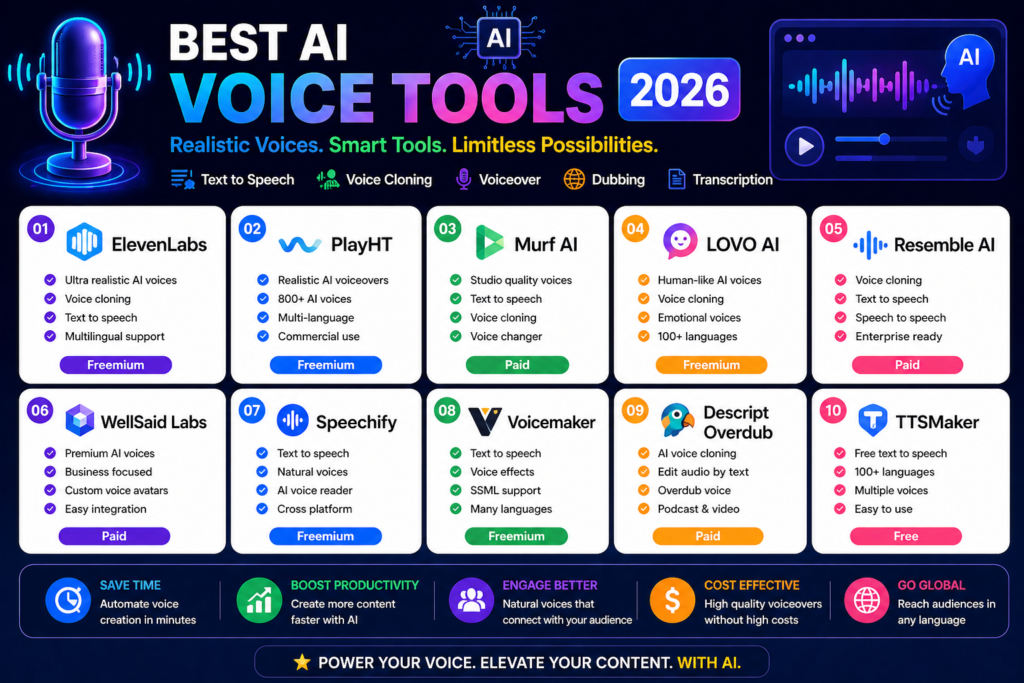
AI voice technology is commonly used for applications such as voiceovers, podcasts, audiobooks, accessibility, education, and multimedia content. Producing audio often involves scripting, editing, recording, and quality review, depending on the project requirements.
AI voice tools can assist with text-to-speech conversion, AI-generated voiceovers, voice synthesis, multilingual narration, and, on some platforms, voice cloning. Available features depend on the selected tool, subscription plan, and applicable usage policies.
These tools may be useful for content creators, educators, businesses, podcasters, publishers, and media professionals looking to support audio production workflows.
How These AI Voice Tools Were Selected
criteria such as:
- Voice quality options
- Text-to-speech capabilities
- Voice cloning support
- Language availability
- Integration options
- Ease of use
- Industry adoption
- Availability in 2026
Responsible Use of AI Voices
guidance such as:
- Obtain permission before cloning a person’s voice.
- Comply with copyright, privacy, and platform policies.
- Clearly disclose AI-generated voices when appropriate.
- Review generated audio for accuracy before publication.
Features, pricing, supported languages, AI voice models, and licensing terms may change over time. AI voice tools can assist with audio production but do not guarantee studio-quality results. Voice cloning should only be used with appropriate permission and in accordance with applicable laws and platform policies. Always review AI-generated audio before publishing.
Voice AI Tools List (Table)
| Tool Name | Common Use Cases | Pricing Model | Official Website |
|---|---|---|---|
| ElevenLabs | Realistic AI Voice & Voice Cloning | Free & Paid plans | 🔗 Official Website |
| Murf AI | Voiceover & Narration | Paid plans available | 🔗 Official Website |
| PlayHT | Text to Speech | Free & Paid plans | 🔗 Official Website |
| Speechify | Audio Reading | Free & Paid plans | 🔗 Official Website |
| Lovo AI | AI Voice Generator | Free & Paid plans | 🔗 Official Website |
| Listnr AI | Podcast Voice Creation | Free & Paid plans | 🔗 Official Website |
| WellSaid Labs | Professional Voiceovers | Paid plans available | 🔗 Official Website |
| Resemble AI | Voice Cloning | Paid plans available | 🔗 Official Website |
| Replica Studios | Game & Character Voices | Paid plans available | 🔗 Official Website |
| Voicemod AI | Real-Time Voice Effects | Free & Paid plans | 🔗 Official Website |
Note: The most suitable AI voice tool depends on your use case, required languages, voice options, licensing terms, budget, and workflow. Compare available features and commercial use policies before selecting a platform.
comparison fields such as:
- Primary Function
- Text-to-Speech Support
- Voice Cloning Support
- Language Support
- API Availability
- Commercial Use Policy
- Audio Export Formats
- Platform (Web/Desktop/Mobile)
- Free Trial Availability
How These AI Voice Tools Were Selected
criteria such as:
- Voice generation capabilities
- Text-to-speech features
- Voice cloning options
- Language availability
- Integration support
- Ease of use
- Industry adoption
- Availability in 2026
Responsible Use of AI Voice Tools
guidance such as:
- Obtain permission before cloning or replicating a person’s voice.
- Follow copyright, privacy, and platform policies.
- Disclose AI-generated voices when appropriate.
- Review generated audio for accuracy before publishing.
Features, pricing, supported languages, AI voice models, integrations, and licensing terms may change over time. AI voice tools can assist with audio production but do not guarantee studio-quality results. Voice cloning should only be used with appropriate permission and in accordance with applicable laws and platform policies. Always review AI-generated audio before publishing.
Popular AI Image Tools in 2026
AI Image Tools in 2026: A Comprehensive Guide
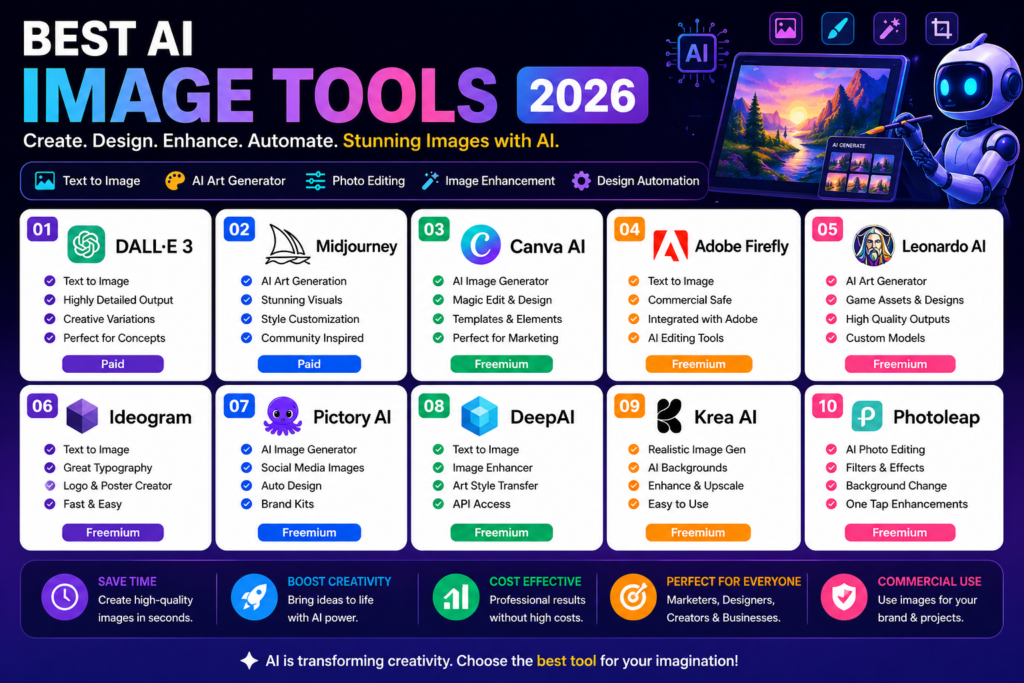
Images are widely used across websites, social media, marketing campaigns, presentations, and digital content. Creating visual assets may require design skills, editing software, or creative resources, depending on the project requirements.
AI image tools can assist with generating images from text prompts, creating illustrations, designing thumbnails, editing visuals, and producing creative assets. The output quality, generation speed, and available features depend on the selected platform and may require human review or editing. The following section compares AI image tools, their primary features, common use cases, and available plans where applicable.
These tools may be useful for bloggers, designers, educators, businesses, marketers, YouTubers, and content creators looking to support visual content creation workflows.
How These AI Image Tools Were Selected
criteria such as:
- Image generation capabilities
- Editing features
- Style options
- Ease of use
- Export quality and formats
- Commercial use policies
- Industry adoption
- Availability in 2026
Responsible Use of AI Images
guidance such as:
- Review AI-generated images before publication.
- Respect copyright and intellectual property rights.
- Check commercial licensing terms.
- Clearly disclose AI-generated visuals where appropriate.
- Avoid generating misleading or deceptive imagery.
Features, pricing, image models, export options, and licensing terms may change over time. AI image tools can assist with visual content creation but do not guarantee design quality or audience engagement. Always review AI-generated images for accuracy, copyright compliance, and suitability before publishing or commercial use.
Image AI Tools List (Table)
| Tool Name | Common Use Cases | Pricing Model | Official Website |
|---|---|---|---|
| Midjourney | AI Art & Creative Images | Paid plans available | 🔗 Official Website |
| DALL·E | Image Generation from Text | Free & Paid plans | 🔗 Official Website |
| Leonardo AI | Design & Game Assets | Free & Paid plans | 🔗 Official Website |
| Playground AI | Creative Image Generation | Free plan available | 🔗 Official Website |
| Canva AI | Thumbnails & Social Media Designs | Free & Paid plans | 🔗 Official Website |
| Adobe Firefly | Professional AI Design | Free & Paid plans | 🔗 Official Website |
| NightCafe | AI Art Generator | Free & Paid plans | 🔗 Official Website |
| Artbreeder | Face & Character Design | Free & Paid plans | 🔗 Official Website |
| Fotor AI | Image Editing & Enhancement | Free & Paid plans | 🔗 Official Website |
| Pixlr AI | Online Photo Editing | Free & Paid plans | 🔗 Official Website |
Note: The most suitable AI image tool depends on your use case, design experience, budget, required features, commercial licensing requirements, and workflow. Compare available capabilities before selecting a platform.
comparison fields such as:
- Primary Function
- Text-to-Image Support
- Image Editing Features
- Style Options
- Resolution/Export Options
- Commercial Use Policy
- API Availability
- Platform (Web/Desktop/Mobile)
- Free Trial Availability
How These AI Image Tools Were Selected
criteria such as:
- Image generation capabilities
- Editing features
- Style diversity
- Ease of use
- Export quality
- Commercial licensing options
- Industry adoption
- Availability in 2026
Responsible Use of AI Images
guidance such as:
- Review AI-generated images before publishing.
- Respect copyright and intellectual property rights.
- Verify commercial licensing terms before business use.
- Clearly disclose AI-generated visuals where appropriate.
- Avoid creating misleading or deceptive imagery.
Features, pricing, AI models, export options, integrations, and licensing terms may change over time. AI image tools can assist with visual content creation but do not guarantee design quality or audience engagement. Always review AI-generated images for accuracy, copyright compliance, and suitability before publishing or commercial use.
AI Tool Categories in 2026: 100+ Tools by Use Case
This section organises AI tools into common categories based on their primary use cases. The list is intended to help readers discover tools relevant to specific workflows. Features, pricing, and availability may vary by platform.
For each category, include a brief description before the list.
AI Search & Research
Tools that assist with information discovery, document analysis, literature reviews, and research workflows.
- Perplexity AI
- Elicit
- Consensus
- Scite AI
- You.com
AI Design Tools
Tools that support graphic design, UI/UX design, image creation, and visual content production.
- Canva AI
- Figma AI
- Uizard
- Khroma
- Designs.ai
AI SEO Tools
Tools that assist with keyword research, content optimisation, technical SEO, and performance analysis.
- Surfer SEO
- Frase
- NeuronWriter
- MarketMuse
- Clearscope
AI Marketing Tools
- HubSpot AI
- AdCreative AI
- Ocoya
- Predis AI
- Anyword
AI Customer Support
- Intercom AI
- Drift AI
- Zendesk AI
- Tidio AI
- Freshchat AI
AI Education Tools
- Khanmigo
- Quizlet AI
- Socratic
- TutorAI
- Mindgrasp
AI Data Tools
- DataRobot
- Akkio
- Obviously AI
- MonkeyLearn
- Tableau AI
AI Music Tools
- Suno AI
- Udio
- AIVA
- Soundraw
- Boomy
AI Presentation Tools
- Gamma
- Tome
- Beautiful.ai
- SlidesAI
- Decktopus
AI E-commerce Tools
- Shopify Magic
- Pebblely
- CopyMonkey
- Flair AI
- Pencil AI
AI Automation Tools
- Zapier AI
- Make AI
- Bardeen AI
- Taskade AI
- Mem AI
AI HR Tools
- HireVue
- Paradox AI
- Textio
- Eightfold AI
- SeekOut
AI Finance Tools
- AlphaSense
- Kavout
- Upstart AI
- Zest AI
- Kensho
AI Healthcare Tools
- PathAI
- Tempus AI
- Aidoc
- Butterfly Network
- Viz.ai
Additional AI Tools:
101. Character AI
102. Janitor AI
103. Pi AI
104. Poe AI
105. Rewind AI
How These AI Tools Were Selected
criteria such as:
- Primary use cases
- Feature availability
- Industry adoption
- Ease of use
- Availability in 2026
- Free and paid plan availability
- Relevance across different industries
Some AI tools may fit into more than one category. They have been grouped according to their most common use case for easier navigation.
Features, pricing, supported platforms, integrations, and AI capabilities may change over time. The tools listed are provided for informational purposes and are organised by common use cases rather than ranked by quality or performance. Always review the official documentation before selecting a platform.
How to Choose an AI Tool: Step-by-Step Guide
With many AI tools available, comparing features, pricing, and use cases can help you identify the option that best matches your requirements. Follow these steps:
Step 1: Identify Your Goal
Ask yourself:
- Do I need content writing?
- Image creation?
- Video editing?
- Coding help?
Your intended use case can help narrow down the tools that best match your workflow and requirements.
Step 2: Check Free Plans
Some AI tools provide free plans, free trials, or limited-feature versions that allow you to evaluate the platform before subscribing
Examples:
- ChatGPT Free
- Canva AI Free
- Perplexity AI Free
If available, testing a free plan or trial can help you evaluate whether the tool meets your needs.
Step 3: Compare Features
Look for:
- Ease of use
- Integrations
- Pricing
- Customer support
- Output quality
criteria such as:
- Privacy and security features
- Data handling policies
- Export options
- API availability
- Commercial licensing
- Collaboration features
- Supported languages
- Platform compatibility
Step 4: Read User Reviews
User reviews and independent evaluations can provide additional insights into usability, reliability, customer support, and real-world experiences. Consider reviewing multiple sources before making a decision.
Step 5: Start Small
Consider starting with a small number of tools and evaluating how they fit your workflow before adding additional platforms.
Questions to Ask Before Choosing an AI Tool
Examples:
- What task do I need the tool to perform?
- Does it support my preferred platform?
- Is there a free plan or trial?
- Does it integrate with my existing workflow?
- Are commercial use and licensing terms suitable for my needs?
- How is my data handled?
- Does it meet my privacy and security requirements?
Features, pricing, integrations, supported platforms, and AI capabilities may change over time. Before selecting a tool, review the latest information on the official website, including licensing, privacy policies, and terms of use. The most suitable AI tool depends on your specific requirements and workflow.
Pros and Cons of AI Tools
Pros
- Can help reduce the time required for repetitive tasks, depending on the workflow and the selected tool.
- May improve workflow efficiency when used alongside human review and expertise.
- Can assist with automating selected repetitive tasks and workflows.
- Many AI tools offer interfaces suitable for beginners, although the learning experience varies by platform.
- Can assist with idea generation, drafting, design, and other creative workflows.
Cons
- Some tools require time to learn, especially advanced features and workflows.
- Advanced features may require a paid subscription or usage-based pricing.
- AI-generated content, code, images, and recommendations should be reviewed for accuracy, relevance, and quality before use.
- Privacy, data handling, and security practices vary between platforms. Review each provider’s privacy policy before uploading sensitive or confidential information
additional benefits such as:
- Supports content drafting and brainstorming
- Assists with research and information organisation
- Can improve accessibility through text-to-speech and translation features
- Helps automate repetitive administrative tasks
- Supports collaboration and workflow management
additional limitations such as:
- Output quality varies between tools
- AI-generated information may contain inaccuracies or outdated content
- Some features require internet connectivity
- Commercial licensing and usage rights differ between platforms
- Integration options vary
- Vendor lock-in may occur when relying heavily on one platform
The advantages and limitations of AI tools vary depending on the platform, use case, and implementation. AI should be viewed as a tool to support human decision-making rather than replace professional judgement. Features, pricing, privacy policies, and licensing terms may change over time.
How AI Tools Are Shaping the Future
AI technologies continue to evolve as new models, features, and applications are introduced across different industries.
Current industry trends suggest that AI tools may continue to support areas such as:
- Personalised user experiences
- Workflow automation
- Content creation and creative assistance
- Business operations and decision support
However, human creativity, critical thinking, ethical judgement, and domain expertise remain important when using AI-generated outputs.
For many workflows, AI is most effective when used as a tool that supports human decision-making rather than replacing it entirely.
Final Thoughts
AI continues to evolve across a wide range of industries, with new tools and features being introduced throughout 2026.
Whether you are a blogger, student, entrepreneur, marketer, or developer, Exploring AI tools may help individuals and organisations improve selected workflows, depending on their goals, use cases, and implementation.
Rather than using every available AI tool, focus on selecting platforms that align with your workflow, budget, technical requirements, and long-term objectives.
As you explore AI tools in 2026, experiment with different platforms, stay updated on new releases, and build a workflow that works best for you.
As AI technologies continue to evolve, staying informed about new tools, responsible AI practices, and emerging capabilities can help individuals and organisations make informed decisions. The importance of AI skills will vary depending on the industry, role, and specific workflow requirements.
Best Practices for Using AI Responsibly
guidance such as:
- Verify AI-generated information using reliable sources.
- Review AI-generated content before publishing.
- Protect sensitive and confidential data.
- Follow copyright, licensing, and privacy requirements.
- Stay informed about platform updates and policy changes.
AI technologies, features, pricing, licensing, and availability may change over time. Future developments discussed in this guide are based on current industry trends and should not be interpreted as guarantees. Always evaluate AI tools based on your specific requirements and verify important information using authoritative sources.